
During our five-week Scotland travels (our third trip here) Joy and I used the words “dramatic” and “beautiful” to describe Scotland’s landscape so often, I felt tempted to consult a thesaurus. “Lovely” and “stunning” filled in for a while, but we usually went back to our standards. Scotland’s diverse landscape is consistently spectacular and impossible to capture on an iPhone. Joy says that Scotland is the most beautiful country ever. “Not that it has the point of greatest beauty, but everywhere is beautiful so the average is off the charts.” The bright green landscape sometimes reminded us of a mix of Kauai’s steep, rugged mountains and Colorado’s stream-roped mountain valleys. We often stopped to marvel at sweeping vistas of stark mountain slopes and glens, the result of glacial scraping, freakin’ steep slopes, as well as massive landscape denuding by sheep & deer grazing.
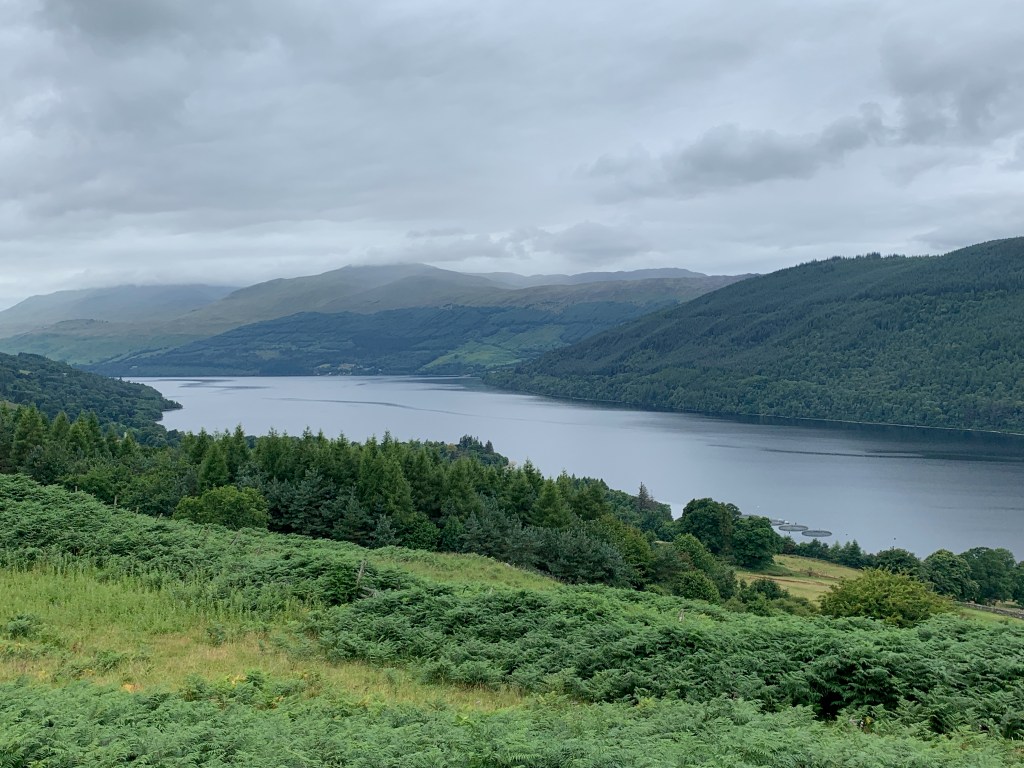

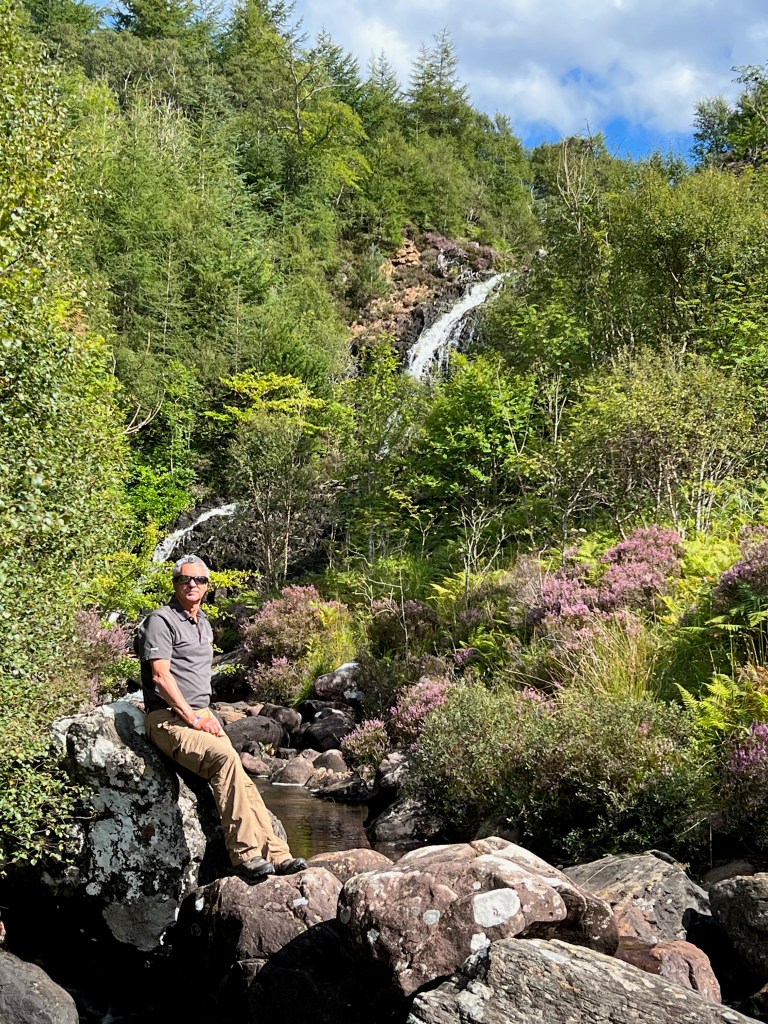
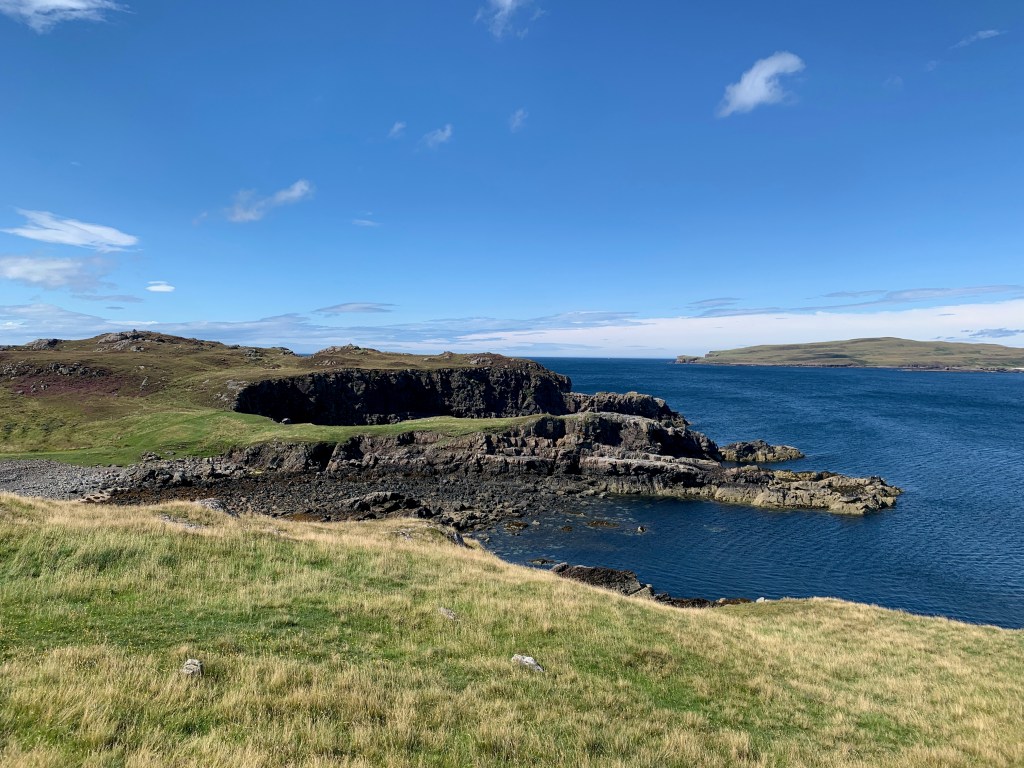
And if you have any interest in geology, Scotland is for you. So many exposed geological layers just right there. You can almost see the glaciers, volcanos and tectonic plates creating the landscape. It’s no wonder Scotland’s unabashed geology has drawn many famous scientists over the centuries.
Everyone we met in Scotland was friendly and welcoming. A few of them were embarrassingly helpful, including the man who invited us into his house and spent two hours helping us get a tow truck out to that desolate stretch of road so we could get what ultimately turned out to be two flat tyres replaced. Scottish roads in some areas of the Hebrides are in sneakily horrible condition and the itty bitty tyres on our Fiat weren’t up to surprise potholes. We weren’t the first tourists this season to walk to his house hoping for a landline to call for help after being bested by Scotland’s treacherous roads. On the plus side, I did enjoy driving a stick shift left handed, even if it was an underpowered car so small it was almost like putting on a coat.
It’s a Dreich Day
“It’s a dreich day,” was an accurate way to describe the more-than-we-expected days that were miserable, cold, and wet. We did have a few sunny days, but most days were grey, with periodic bouts of rain. We’d planned to visit Scotland in August so that we could attend the Fringe festival, but also so we’d have the least chance of rain. Sadly, August turned out to be unusually dreich and even locals were lamenting August’s weather. On the other hand, Scots are the most optimistic people we’ve ever met. Nearly every house has a clothesline outside, often with clothes pinned on to dry.
We also learned the hard way that if the official local weather forecast in Scotland shows “absolutely no chance of rain” that it will still probably rain at some point. Several times we were fooled by sunny skies, went outside without rain gear, and twenty minutes later we were drenched.
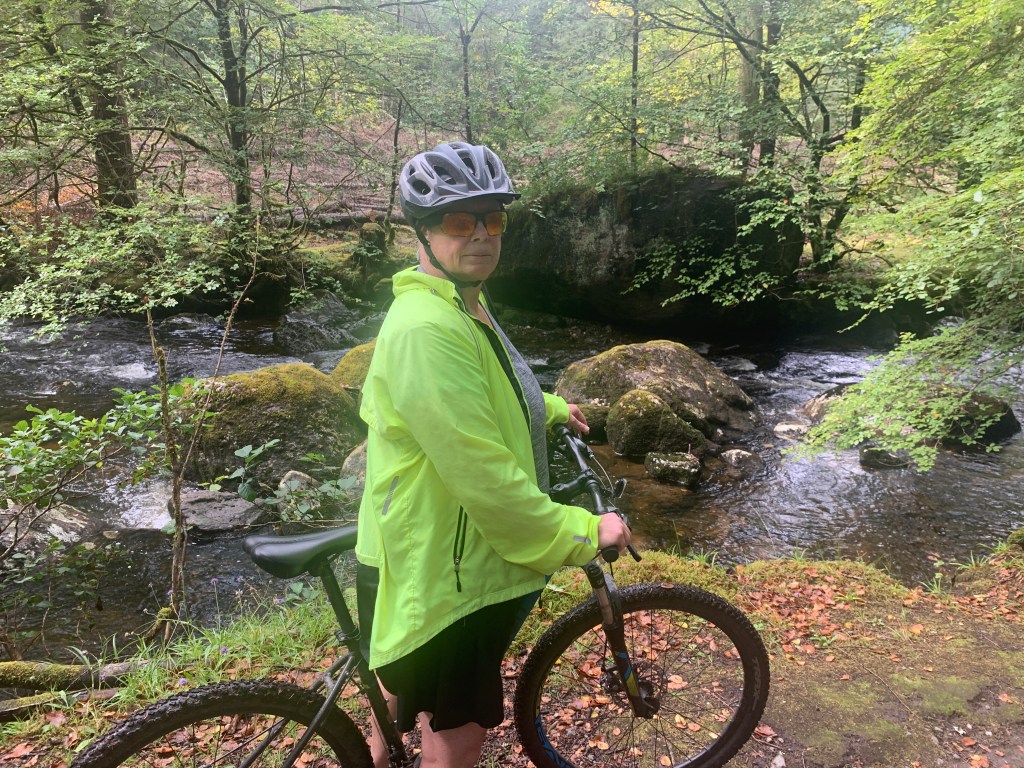
Thanks to all that water, Scotland has more than 30,000 fresh water lochs, and so many lovely waterfalls, cascades, rivers, creeks, streams, brooks, rills, runnels, and springs that I had to force myself to stop taking pictures of them. Scotland also has spectacular clouds. There was also a lot of mud, but I didn’t take any pictures of that.
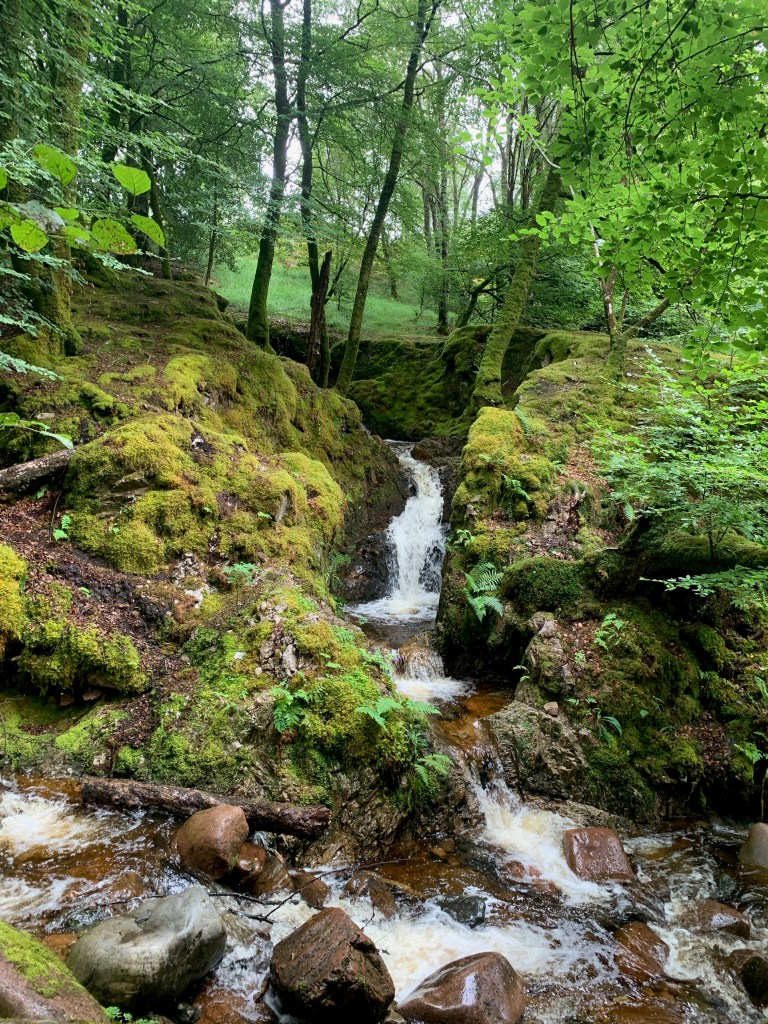
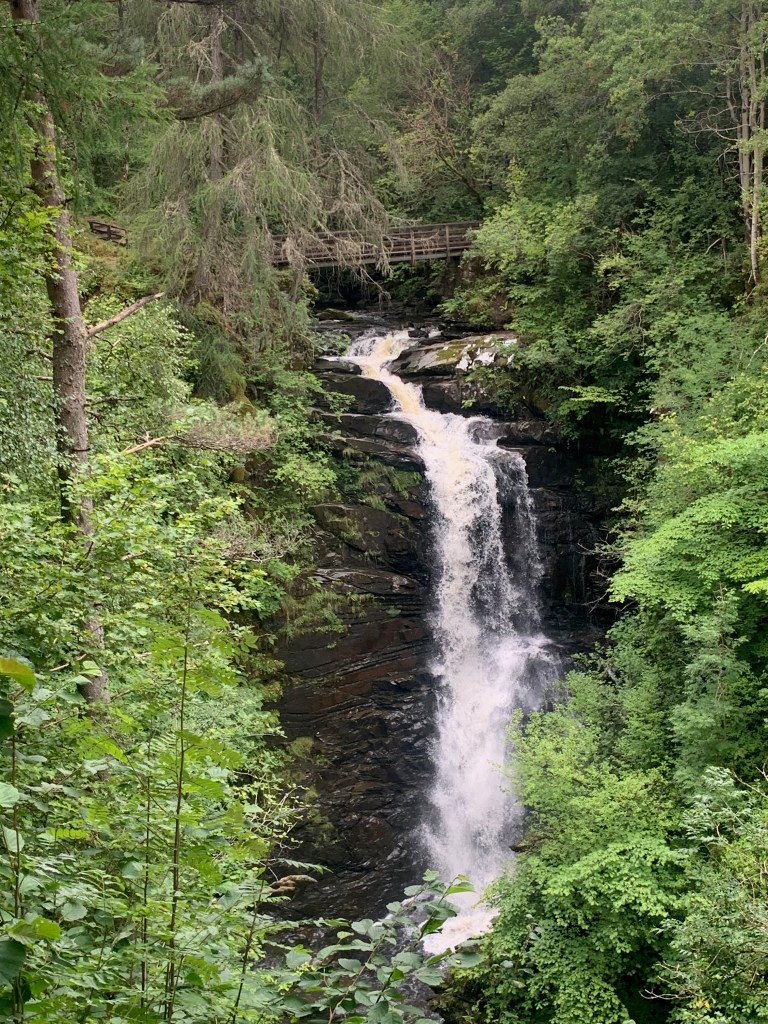
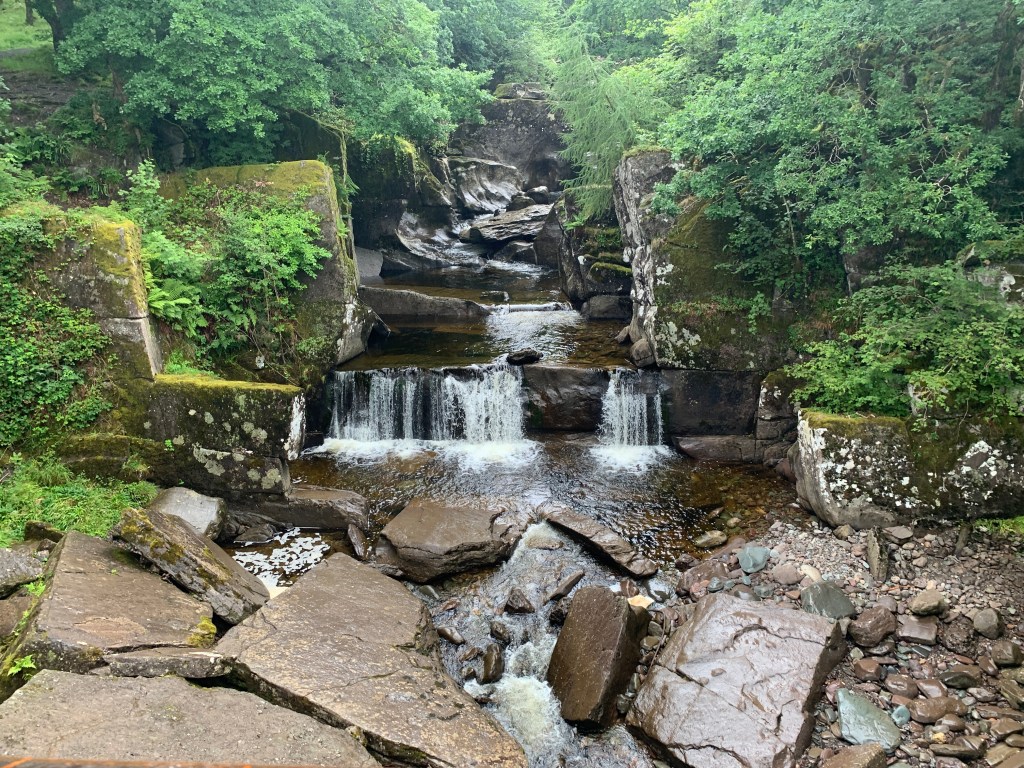
We had many memorable conversations with Scots about their weather:
- “There’s no such thing as bad weather. Just bad clothing.”
- “In winter, it’s cold, windy, and damp. In summer, it’s mild, windy, and damp.”
- “If you don’t like rain, why did you come to Scotland?”
- In response to Joy’s comment that we’d been hoping for drier weather, a taxi driver quoted Alexander Dumas, “You live with hope and die with despair.”
- “Our weather is bipolar. “
- “If you don’t like the weather, wait 5 minutes. If you still don’t like the weather, sod off back to England.”
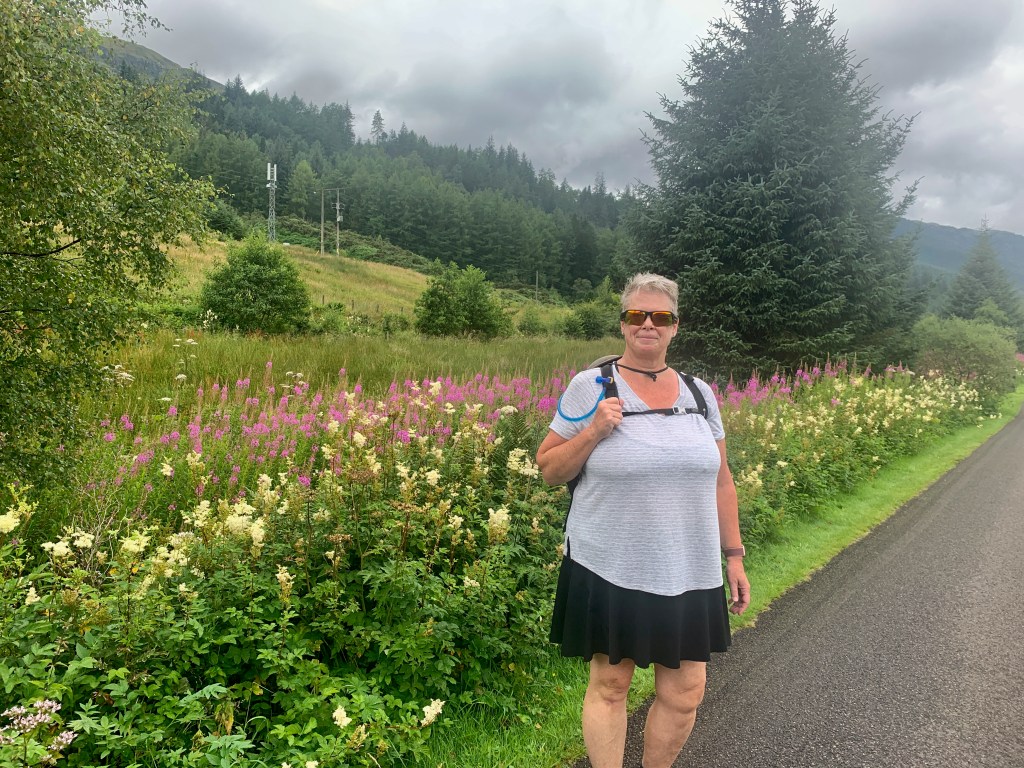
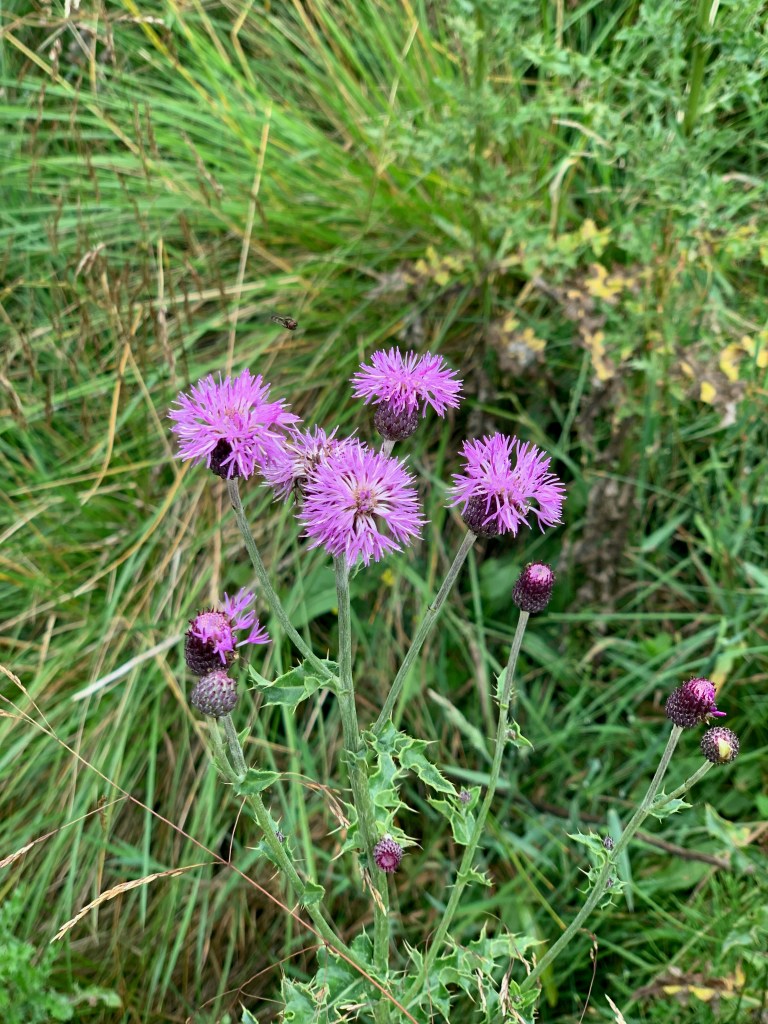
On the plus side, we were treated to lavish wildflower displays, hillsides purpled by heather, and a million blooming thistles (Scotland’s national flower).

Scottish Food & Drink
You can’t really say that you’ve experienced Scottish cuisine if you’ve skipped experiencing salmon, whisky, haggis, Cullen skink, and Irn-Bru.
Salmon. We ate a lot of salmon. Okay, we know that it’s farmed and therefore bad karma, and it doesn’t compare to wild Pacific Northwest salmon. But still, it is tasty. And as the official Sottish salmon industry website so proudly states, “Scottish salmon has a lower carbon footprint than most other farming sectors, and produces more edible meat for every tonne of feed used,” so at least it’s better than beef, lamb, or pork.
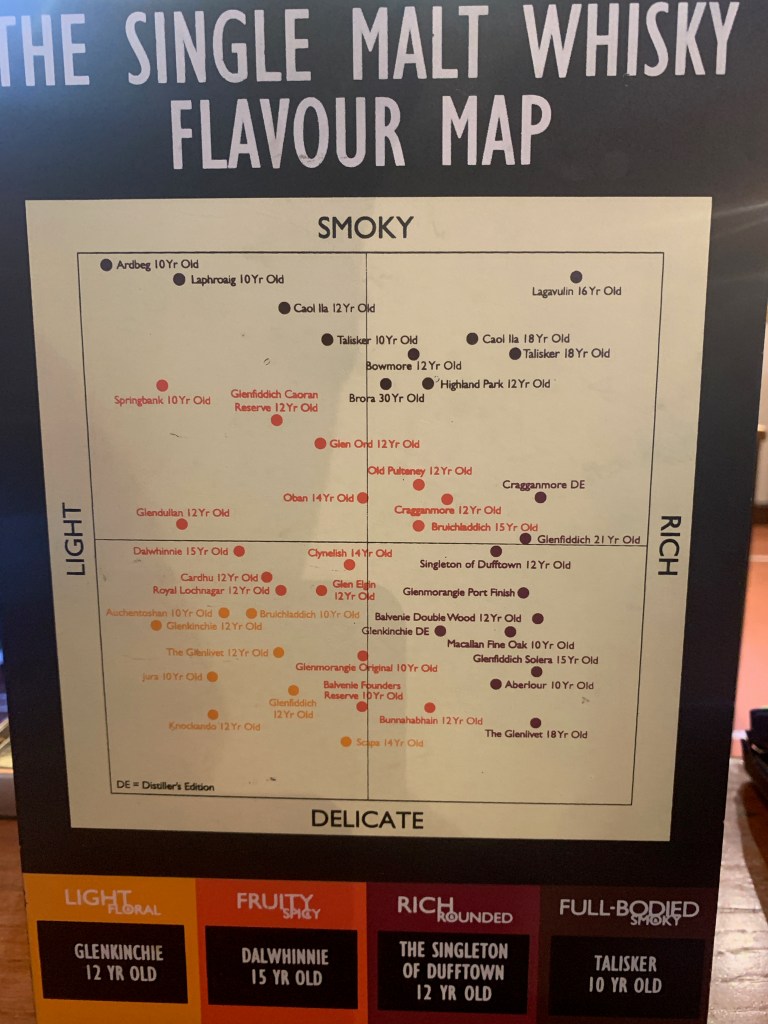
Whisky. We tasted a number of whiskys (mostly Single Malt Scotch Whisky) we’d never had before. There are over 140 Scottish distilleries, so that’s a ton of possibilities. Touring distilleries turned out to be challenging. We did get to Cragganmore distillery, but quite a few no longer offers tours (Covid policy changes/staffing shortages), and others were totally booked out for months. Nevertheless, we soldiered on and found new favorites to add to our list: Glen Allachie 10 & Glenturret 12 (but at only about £75 a bottle, we won’t be buying those very often). We took a whisky tasting “class”. Watch our instructor’s video to learn how to drink whisky without the hassle of flying to Scotland.
Haggis. We’ve experienced it before, but this trip, we had it several times as a component in a complex dish. Most folks know haggis is disgusting without knowing what it is. Haggis is a mixture of sheep’s pluck (heart, liver, and lungs), mixed with spices, oatmeal, and suet (raw lamb or beef fat) and traditionally cooked in the sheep’s stomach. According to Larousse Gastronomique, “Although its description is not immediately appealing, haggis has an excellent nutty texture and delicious savoury flavour.” It’s often referred to as a “pudding” (the UK calls lot of things “pudding”) but it’s like a dry, crumbly ground beef concoction. Its components are undeniably gross, but it’s surprisingly tasty — in small portions and only on rare occasions.
Cullen Skink. Not made of lizards, Cullen skink is is a smoked haddock-based fish stew that reminded me a lot of clam chowder. I had it several times.
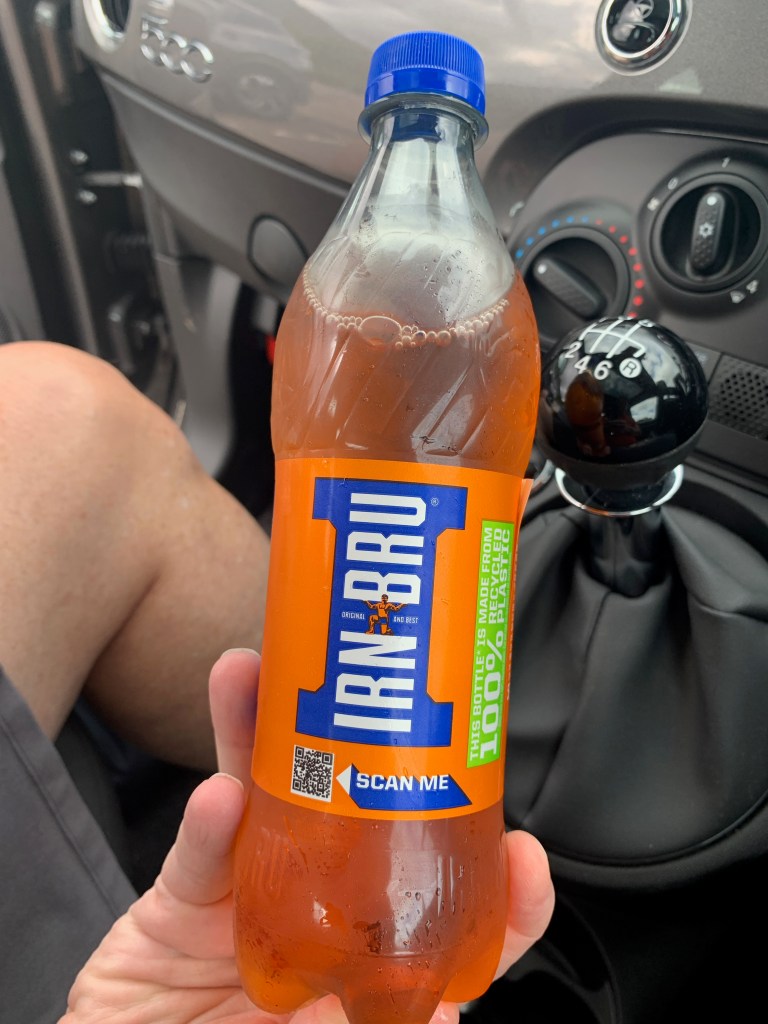
Irn-Bru. We kept seeing signs for this, with the tag line, “Scotland’s other national drink…” Turns out this bright orange carbonated soda is Scotland’s top-selling soft drink. All I can say is that all that whisky drinking must have killed everyone’s taste buds. I could only drink about 1/3 of a bottle.
Rob Roy Way Walk
Scotland’s panoramic landscapes just entice you to strap on hiking boots and go for a hike. Near Glencoe, perhaps one of the most beautiful stretches we’ve ever driven through, throngs of tourists answered the siren call to “get out there.” With so many cars parked along the roadside and so many pedestrians, it felt like driving through Yosemite Valley.
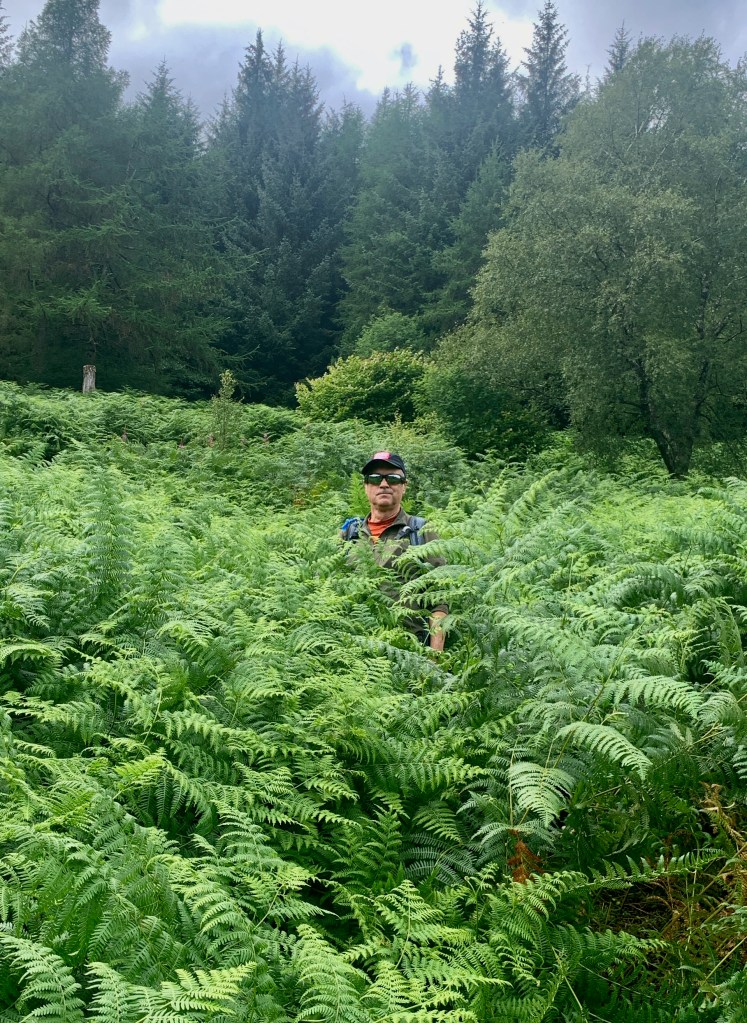
Although we tried to squeeze in a walk through the Scottish countryside almost every day, we did serious hiking during the week we spent walking along a portion of the 128 mile-long Rob Roy Way. Forest road and mountain tracks took us through tree forests, forests of ferns almost as tall as I, along the shore of Loch Tay, and open moorland. Much of the scenery was beautiful or dramatic. (Thanks to friends Aaron and Lois for the recommendation.) While the scenery was captivating, the wildlife viewing was underwhelming. We did see birds and deer during our walk, but never saw a Red squirrel. After our recent trip to Kenya, it’s definitely a letdown when the best you can hope for is to spot an endangered squirrel (only 120,000 left in the UK, 80% in Scotland). It’s also weird to hike through forest and realize that there is absolutely no creature you need to worry about — no mountain lions, coyotes, bears, elk, not even raccoons or skunks! It kinda takes some of the thrill out of it. At the very end of our time in Scotland we finally saw a Red squirrel (which I nearly ran over when it sprinted across the road just in front of us).
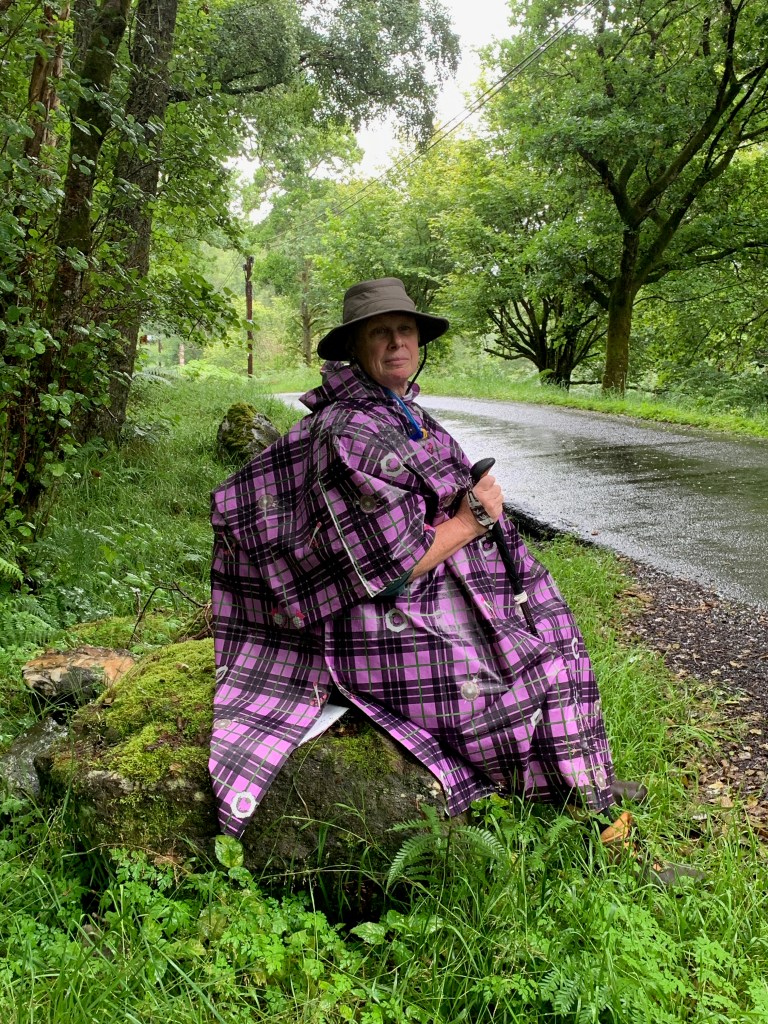
We were lucky that only a few of our Rob Roy days were dreich days. We would have been drowned rats, but we had splurged on £3 ponchos that mostly kept us and our daypacks dry. Even though the weather wasn’t so cooperative, I wish we’d organized for a longer walking tour.


Edinburgh Fringe Festival
Imagine that a Renaissance faire, America’s Got Talent, and the San Francisco Bay-to-Breakers race had a three-some and produced offspring. That’s what the Edinburgh Fringe festival was like. According to Wikipedia, Fringe is “…the world’s largest performance arts festival, which in 2019 featured more than 59,600 performances of 3,841 different shows in 322 venues.” Only the Olympics and the World Cup are bigger. There’s a heavy emphasis on comedy, but shows include cabaret & variety, drama, dance/circus performances, magic, music, musicals, and a mind-boggling amount of buskers (street performers). Fringe is an “unjuried” event, meaning there’s no screening process. You end up watching well-known professional performers, seasoned semiprofessional acts, or subway buskers who think they’re good enough to register as a performer.
The streets of Edinburgh (some of them temporarily converted to pedestrian-only avenues) were packed with hordes of attendees wandering around; musicians, magicians, jugglers, and acrobats performing their acts; food trucks and pop-up cafes hawking their wares; and costumed performers handing out fliers for their upcoming shows (and practically begging you to attend).
Each day during the month-long festival the number of shows available is incredible. The show schedule runs from 8:30am to 3:00am each day. To give you a sense, the show listing for August 15 was 124 pages long! In early June I spent 30+ hours (not an exaggeration) figuring out which shows we should see. Fortunately, most shows have YouTube snippets from previous or related shows. A lot of comedians dropped off because I couldn’t understand their accents or because the humor was too political (we wouldn’t get those jokes). We ended up booking tickets for 12 shows for our 3 1/2 day visit! Plus we watched a lot of street performers.
This year there were only 3,553 shows (from 67 countries), 500 street performers, and just 287 venues (Fringe is still recovering from Covid). Anything could be a venue: real theaters, university lecture rooms, church event rooms, private rooms in pubs. A few were so intimate they were almost microscopic. Several times Joy and I sat in the first row, or close enough that the performers interacted with us. One comedian saw me explaining a European political joke to Joy and once he learned we were American, he blended us into the show, stopping to explain things to us, like, “He’s a rich arsehole,” which made everything that much funnier.
Some of the highlights (with associated links, which open in new browser windows):
- Yippee Ki Yay– a one-man retelling (in AABB rhyme scheme) of the movie Die Hard.
- Jo Caulfield (comedy). She was very funny, but the best part was that a hearing-impaired older woman and her daughter were in the front row. The comedienne made a joke about masturbation, which turned out to be even funnier when the whole audience got to learn that sign language for the word “masturbation” is exactly what you think it would be.
- … And This Is My Friend Mr Laurel – a touching one-man play about Stan Laurel visiting a dying Oliver Hardy.
- Inside Everyone – one man show about an atom that travels to Earth, finding himself inside the world’s most important people. Stupid, but funny (ala Monty Python). Not from the show but gives you a sense: In the Body Compilation.
- 2 Guys, 3 Drams – two guys playing blues, and teaching the audience about whisky (via tasting).
- Several of the buskers were quite good. We saw enough jugglers and acrobats to realize that there is a standard structure, pattern, and gimmicks to how you perform that kind of show.
We also had a few misses, including one ensemble show that was an amalgam of “Shakespeare’s most famous death scenes”. This is one of those things that sounds better on paper than it was in real life.
I created a two-minute video of select Fringe moments (opens in a new window). I guarantee you’ll laugh: Edinburgh Fringe Snippets
Language
In Wales it was pretty obvious when locals were speaking English vs Welsh. In contrast, we were often not quite sure what Scots were speaking. It could be Scottish English (accented English) or one of the two Scottish languages (Scots or Scottish Gaelic). Scottish accents can be so strong it was embarrassing how often we’d ask someone to repeat themselves. Or, after the conversation had ended, Joy and I would caucus and try to piece together what we thought the person had said. Joy decided that Scots are the hardest English speakers to understand, and not just because of their accents. We noticed that they talk fast. I found several references on the web (so it must be true) that state Americans tend to speak at about 125 words/minute. Folks from the general UK population speak at 140 words/minute, and Scots cram 189 words into a minute.
Scots Gaelic is derived from Irish, and is mostly spoken in the northwestern area, particularly the Outer Hebrides. Only about 1% of the population speaks this. Scots is mostly spoken in the Scottish lowlands (essentially everything that isn’t the Highlands). About 30% of Scotland’s population can speak Scots. There are recent efforts to teach Scots in schools, so that percent should grow.
Folks from Glasgow (who refer to themselves as “Glaswegians” but are sometimes referred to as “Weegies”) are known for their weird-ass slang, including: Awa’ an bile yer heid (“away and boil your head” for “get lost”), and Havnae a scooby which means “haven’t a clue.” (BTW, I havnae a scooby if that slang is related to the cartoon dog & his meddling friends.)
Almost everything was only printed in English though signs welcoming you to a town were usually printed in English & Scottish Gaelic, as were a few historic markers or natural history displays.
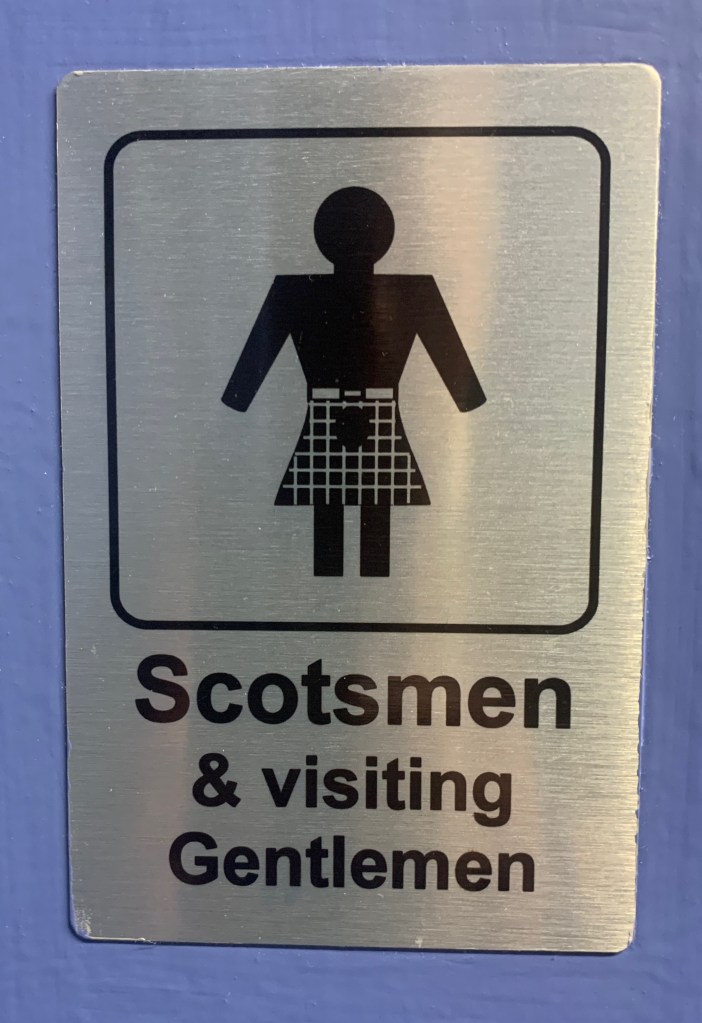
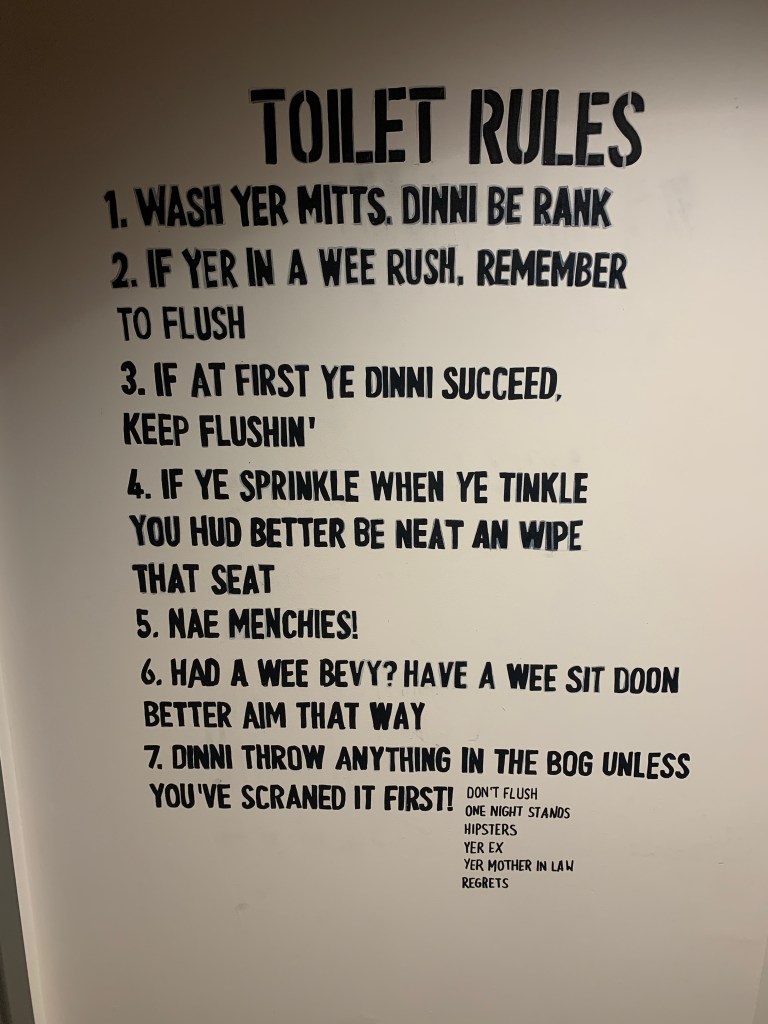
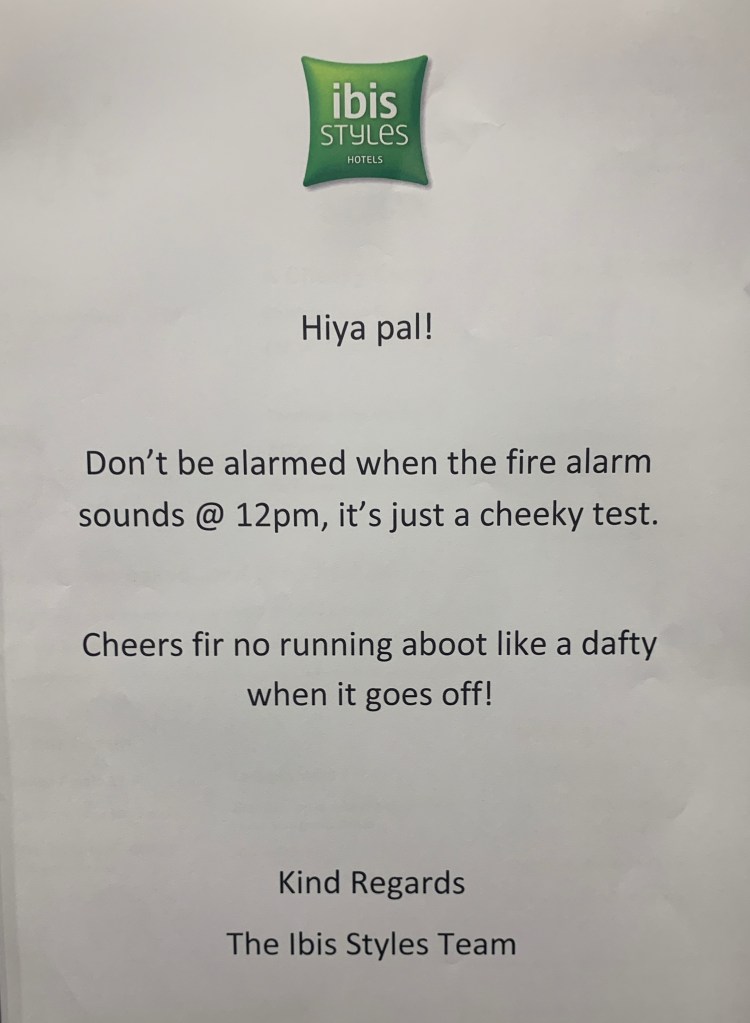
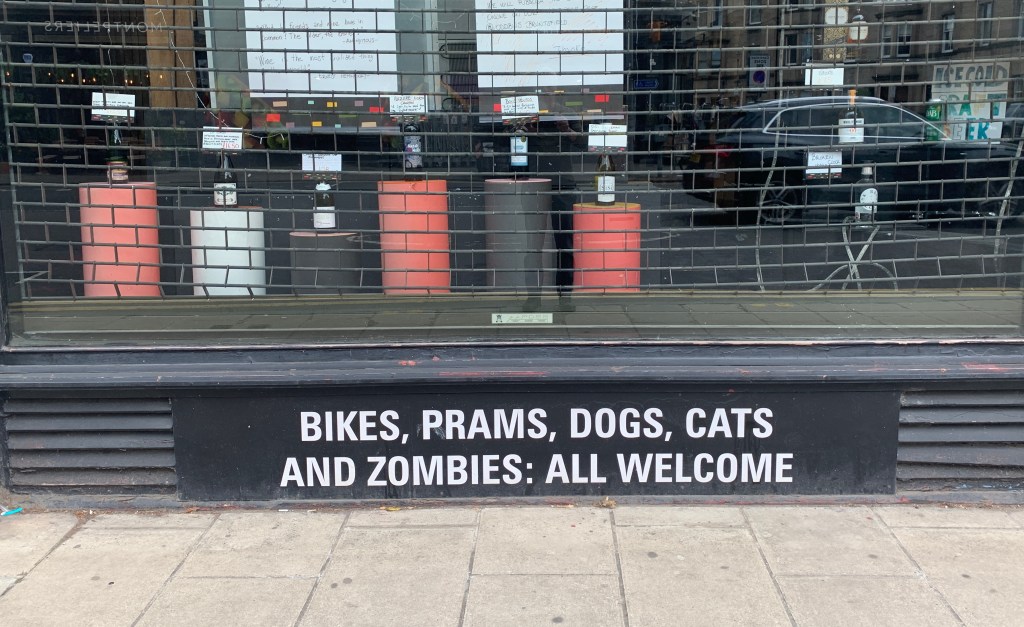
Regardless of which language they’re speaking, Scottish people enjoy language and jokes. We’ve seen more funny/clever signs in Scotland than anywhere else on this trip. Signs are often cheeky, which I think is a wonderful way to approach the world. Here are a few of the examples of those kinds of signs:
Random Bits of Scotland History
In our Wales post I mentioned that the Welsh were tough customers and put up a great fight against invaders. The Scots are even more so. The Romans had a presence is Scotland, but most of it was never incorporated into the Roman empire (maybe because resources weren’t so great, or maybe because the Scots were such a pain in the butt). Around 120AD Emperor Hadrian created his wall across the narrowest part of what’s now England and decided that was Rome’s northernmost border. About a 100 years later the Romans moved further north into what they called “Caledonia” but didn’t stay very long. Lots of inns, pubs, and stores leverage “Caledonia” in their names. “Alba” (Scottish Gaelic name for Scotland) shows up in a fiar number of company names, too.
That independent streak continues today. In 2014 Scotland officially considered breaking away from the UK. In that referendum, 45% of the voters opted to leave. There is still simmering interest in leaving but several factors, including the misadventure called “Brexit”, seem to have dampened the possibility.
I’ve never really understood clans and while I’m more educated about them now, it’s a complex social and historical structure that still leaves me perschmuggled, even after a museum describing clan history. A few things did stick, though. I learned that most clan members weren’t necessarily related to the clan. Tenant farmers would change their surname to match the clan chief’s as a show of loyalty. That’s how you end up with so many MacDonalds. I was surprised to learn that clan tartans are a relatively new invention. Highlanders wore tartans for generations but the patterns were locale-based and only started being associated with specific clans around the 19th century. New tartans are still being created all the time. A number of stores were selling the “Prince Dianna Memorial Tartan”, for example.
You may remember that I’m fan of Wales’ national flag (yeah, dragons!). In contrast to Wales, where the flag was everywhere, we rarely saw Scotland’s flag, probably because it is super boring. Sorry, Scotland, but a blue background with a large white “X” basically looks like a traffic sign.
Scottish Gems — Serendipitous & Otherwise
Here are a few additional highlights, some that we’d planned, and a few that we stumbled upon.
The Hebrides. The Inner & Outer Hebrides are the archipelago of islands off Scotland’s northwest coast. Weather and reduced ferry capacity stymied our plans to get to the Outer Hebrides, but we did spend time on the Inner Hebrides, and the Isle of Skye, in particular. Who’d have thought Scotland would have beautiful sandy beaches with swimmable blue coves at basically the same latitude as Juneau, Alaska? And tyre-killing roads.
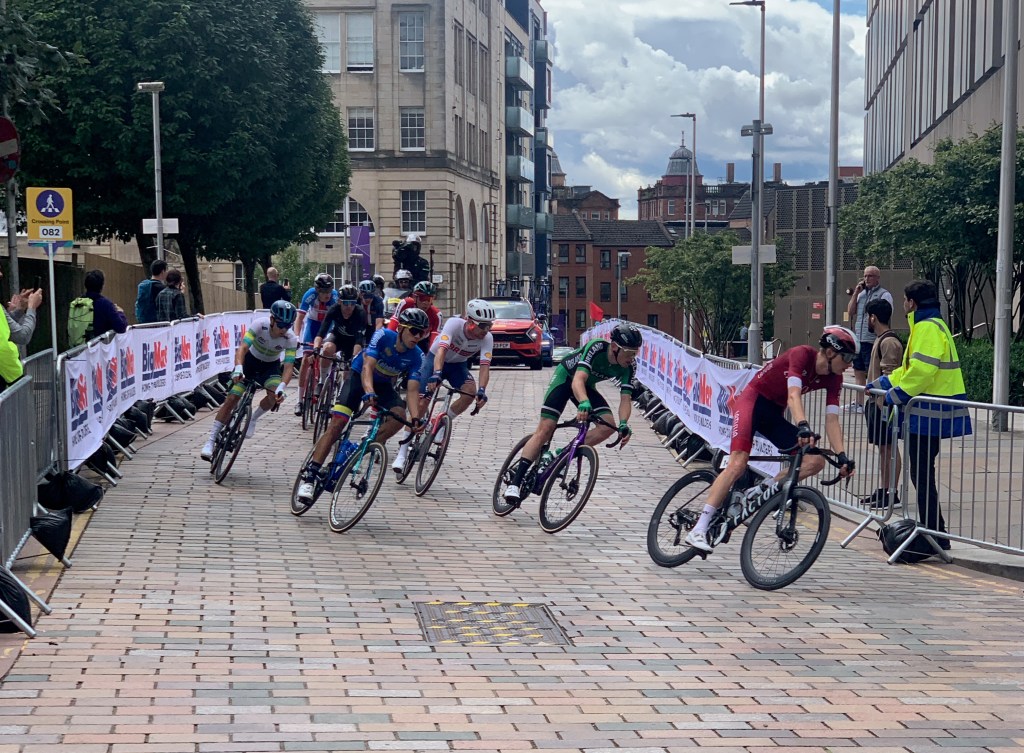
UCI Cycling World Championships.: Purely by coincidence we found ourselves in the middle of the Union Cycliste Internationale (UCI) Cycling World Championships, a 10 day event that includes men & women’s BMX freestyle, BMX downhill, road races, indoor track, team time trials, etc. Our Glasgow hotel was a block and a half from the finish line of the 277km (~175 mile) course that ran from Edinburgh all the way to Glasgow where it made 10 laps through central Glasgow. It was fun to watch the cyclists zoom by, which happened several times over the three days we were there. Several not very rich national cycle teams (India, Greece, Ukraine, Trinidad & Tobago, & Barbados) were staying at our hotel. We never saw them loitering in the lounge or over breakfast, though.
Stirling Castle & William Wallace. There are between 1,000 & 2,000 Scottish castles remaining, depending on which website you visit, and what you define as “remaining.” We visited just a few. One of our favorites was Stirling Castle, which is one of Scotland’s largest and most important. The current castle, an amalgam of several castle remodels starting in the 1500’s, has been sieged eight times! Lots of history happened there, including Mary, Queen of Scots was crowned there. From its walls you can see the battlefield where William Wallace (think Mel Gibson’s blue face) routed a far superior English army. It’s also home to the “Stirling Heads,” round carved oak portraits of famous people attached to the ceiling of the King’s Presence Chamber. Very cool.
Russian Arctic Convoy Museum. Because I needed to pee, we pulled into this gem of a museum dedicated to Allies’ World War II efforts to get much needed food, aircraft, and weapons to Russia so they could keep fighting Germany. It’s a touching museum that brings to light the bravery of until recently ignored WWII heroes.
Doune Castle. This castle is where the insulting Frenchman in Monty Python and the Holy Grail says, “I fart in your general direction. Your mother was a hamster and your father smelt of elderberries.” Just in case you need a refresher, here’s that 2 minute scene (opens in a new window). The castle audio guide was narrated by Monty Python’s Terry Jones and you can buy coconuts in the gift shop! Also filmed there, the Outlander TV series and two 2018 movies Mary, Queen of Scots (starring a pre-Barbie Margot Robbie), and Robert the Bruce starring Star Trek’s Chris Pine. Oh, and some historical stuff happened there, too.
Falkirk Wheel. One of the most impressive pieces of engineering ever: a boat elevator that turns what was once an all day, 11-lock process to raise a boat 34 meters (111 feet) into a 15 minute process. So unbelievably cool. And one rotation only uses the energy required to boil 8 kettles of water! Here’s a one-minute video of the wheel in action (opens in a new window): Falkirk Wheel in action.


Running 11 Month Travel Totals To Date:
8 months into our 11 month trip we have been in:
- US States: 7 (Oregon, California, Arizona, New Mexico, Texas, Louisiana, Mississippi)
- Countries: 13 (US, Mexico, Cuba, The Netherlands, France, Switzerland, Germany, Austria, England, Kenya, Wales, Greece, Scotland)
- plus two unofficial, 60-second visits into Guatemala and Tanzania for Tony
- Continents: 3: North America, Europe, Africa
- Different beds: we’ve slept in 105 different beds (114 if you include same hotel/house but different rooms each visit), which averages to a different bed either every 2.3 or 2.1 days
 Itinerant Philosopher
Scotland seized my heart.
Magical, exquisite and rugged.
I have a new relationship with the color green .😀
LikeLike
THis was both correct and very funny: “If you don’t like rain, why did you come to Scotland?”
LikeLike
As always, I love receiving your tale of adventure. Plus, it reminds me (and others to whom I mention your tales) of Frannie. What a super gal, and how you cheered her up in her final months. I’m doing well, and feel I’m traveling with you periodically. Melanie T.
LikeLike
What a delightful blog! Thank you for sharing. Scotland sounds truly incredible. I’d take the rain over drought any day.
LikeLike
As always I love to read through your updates, but I would be remiss (and you would be shocked) if I didn’t say there aren’t enough circus shows in your video.
LikeLike
I really appreciate the humor. I can understand the sense of adventure. I miss those days with thoughts of joy. David Sacks
LikeLike