
This post covers our adventures around Wales & a bit more of England, sandwiched between our Kenya trip and a quick jaunt to Greece for a wedding. (Pro tip: if a family member schedules a wedding in Greece in mid-July, consider scheduling an unpostponable operation.) After Greece Joy and I headed to Scotland for several weeks, and this post provides some background for that upcoming adventure summary, as well.
Wait, what country am I in?
For those of you who went to US public elementary school (or were raised in California, like me) and therefore don’t have any sense of world geography, I’ll start with a quick recap of how Wales (and Scotland) fit into this part of the world.
- The United Kingdom (UK) is a nation consisting of four countries: England, Wales, Scotland, and Northern Ireland. (You would know this if you watched Ted Lasso.)
- The British Isles consist of two big islands and shit-ton of little islands (whose names might be important, but not to me). The largest island, closest to Europe, is Great Britain while the island to its west is home to the two Irelands.
- Great Britain (GB) is home to England, Wales & Scotland, and where we’ll have spent ~three months of our eleven month travel adventures.
- England, the biggest of the four UK countries, politically & culturally dominates everyone else in the UK. We wrote about our 30 Day Jaunt Around England in a previous post.
- Wales (“Cymru” in Welsh), on the west coast of GB, sits across the Irish Sea from the Republic of Ireland (which is NOT part of the UK).
- Scotland, to the north of England, is across the Irish Sea from Northern Ireland, which is part of the UK.
- But what about Cornwall? Cornwall is the southwestern-most part of Great Britain (the part that just kinda dangles out there between the English Channel and the Atlantic Ocean). The Cornish people aren’t nearly half as fierce as the Welsh and their culture was overrun by the English centuries ago. No country for old Cornish men. The best they could get is a county.
- Well then, who the heck are the British? Basically any citizen of Great Britain, but I don’t think you’d actually want to refer to a Welsh person as British since it’s pretty strongly associated with being English.
- Okay, there are a couple other notable British Isles I care about, including the Scottish Orkney Islands, which have some of the most amazing archaeological sites we’ve seen (we visited in 2017), and we may visit the Hebrides and Isle of Mann this August.
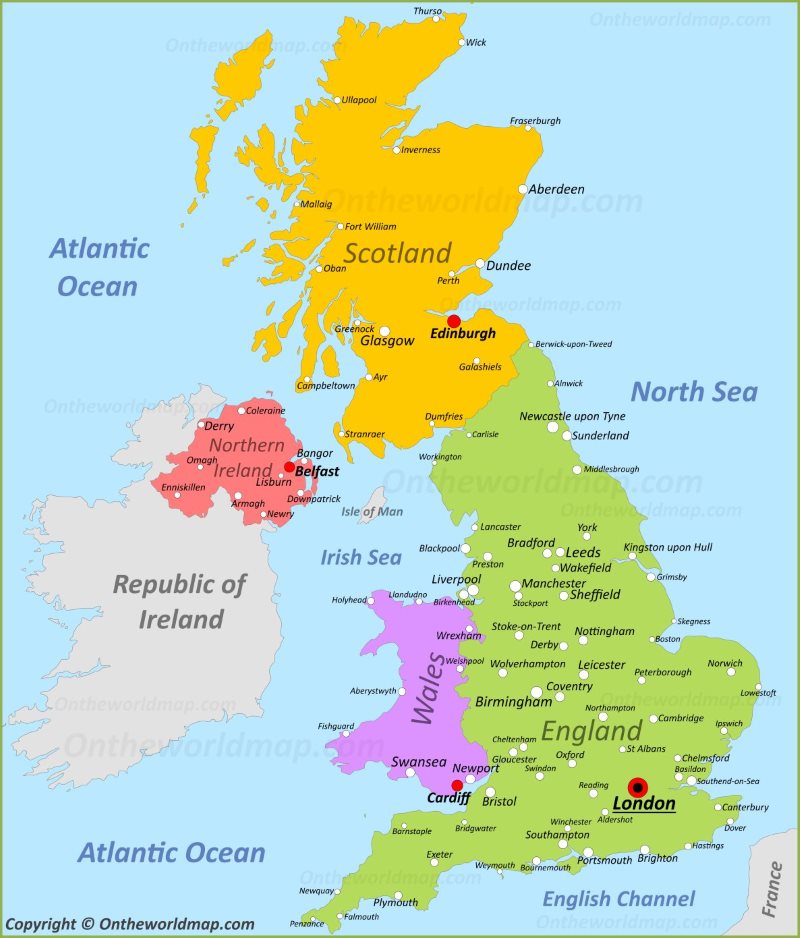
If you still don’t get how it all fits together, here’s a OntheWorldMap map which offers free printable maps:
Cymru
We loved Wales. It’s a beautiful, rugged, mountainous country outlined along its west coast with a mixture of tall, craggy shale & limestone cliffs and beautiful stoney beaches. I fell in love with the feel of many of the towns and villages which always felt tidy & welcoming. Homes are often either faced in stone or painted vibrant colors. I didn’t manage to capture a good photo of the houses, but the cheek-to-jowl pink, green, blue, or yellow houses (particularly in Aberystwyth) reminded me of color-loving Oaxaca, Mexico.
We spent about 10 days traveling around Wales. We started in its northeastern-most region, in the town of Conwy (yes, it’s spelled that way), just a bit west and south of Liverpool, England (see the map). We then drove counter-clockwise along Wales’ coast, dipping inland periodically, and ended our travels in Cardiff, Wales’ capital, before heading to London.
We owe most of our itinerary to Stanford English Professor (& Welsh medievalist) Elaine Treharne, who’s from the seaside town of Aberystwyth, Wales. We borrowed most of the itinerary from the Stanford Alumni trip she’s leading later this year. (Hey, she told me to. Plus, Joy and I are both Stanford alumni, so that seems totally okay.)
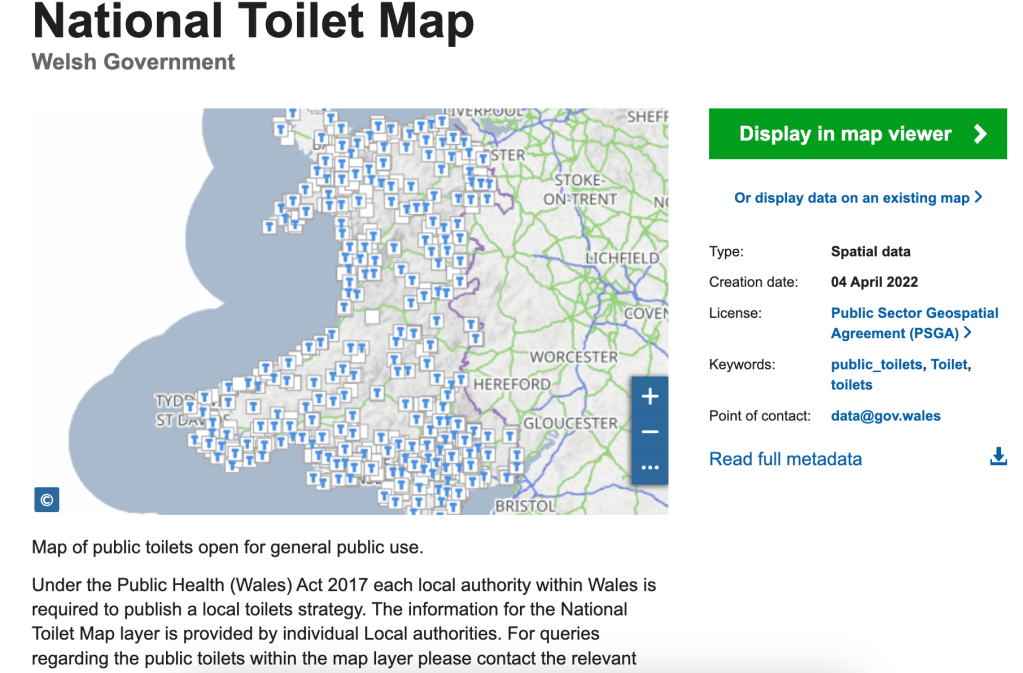
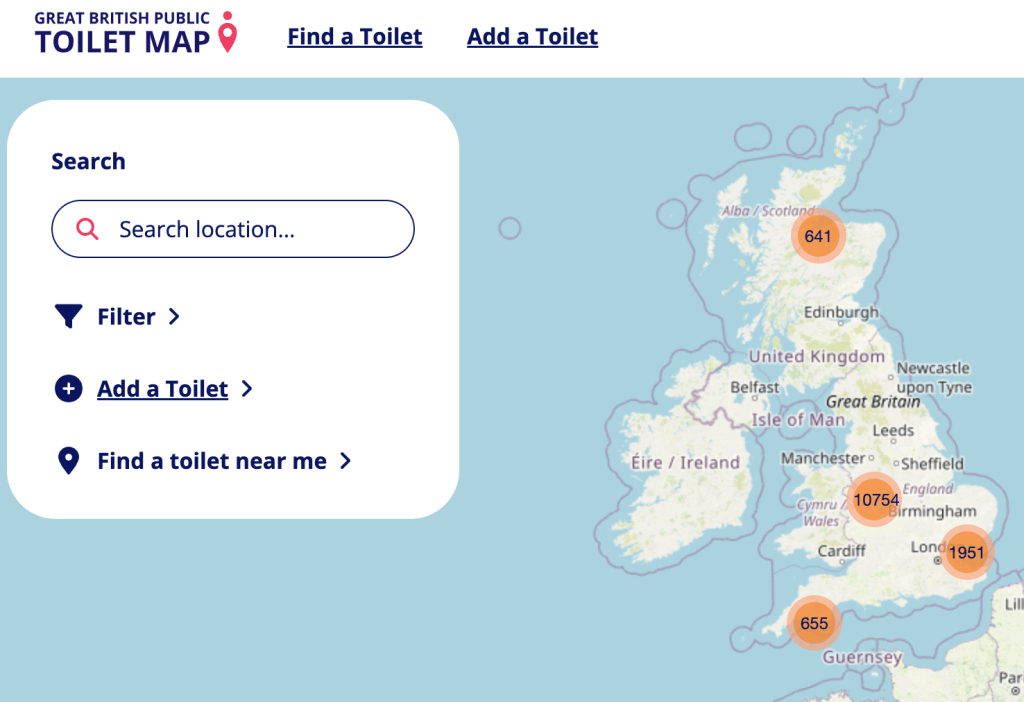
While researching Wales, I stumbled across a remarkable map: Wales National Toilet Map! The Wales Public Health Act 2017 mandates that each local Welsh authority publish a local toilets strategy. A toilets strategy! This is brilliant! I love Wales. You can click on any toilet to see its hours, # of stalls, etc. Besides being personally valuable to me, it’s also a great geospatial resource useful for scientists and analysts. You could correlate this data with other sources to look at health trends, socio-economic patterns, political trends (maybe explain why some groups are so tight-assed), etc. It turns out that the UK as a whole has a similar toilet map, which let you see at a glance that England has a shitload more public loos than Wales or Scotland.
We did leverage a few other “what to visit in Wales” resources, but I was really taken by the toilet maps. Of course, we don’t really need a “loo finder” in the US because there’s a Starbucks every 300 yards, and they has an “open door” bathroom policy. Hmm. Maybe I should phrased that better..
Waving the (Welsh) Flag
Let me start by saying that as far as I’m concerned, Wales has the world’s best flag. How could you not like a dragon on your flag? I was happy to add the Welsh cap to my collection of “baseball caps for each US state & country I’ve visited.”
We saw the Welsh flag everywhere in Wales. It felt like we saw the flag flying over most public & private buildings, homes, stores, and pubs. And the Welsh dragon on shirts, caps and bumper stickers.
It’s cool to see a country where folks wave their flag because they are enthusiastic to be from there. It made me miss the days when Americans displayed the flag as a US-wide patriotic act rather than as a political statement.

Although everyone speaks English, we heard a lot of folks speaking Welsh. According to Mr. Wikipedia, as many as ~30% of people in Wales now speak Welsh, which is a big increase thanks to several nation-wide efforts in the late 20th century to promote Welsh. After centuries of being kind of culturally bowled over by the English, in 2011 Wales added Welsh as an official language.
Here’s a video of a National Trust volunteer at Caernarfon Castle explaining something in Welsh to school kids. Part way through he notices me and pauses his lecture a moment to say something to/at me which leaves the kids chuckling.
If anyone knows Welsh…
(Press the arrow to play the video.)
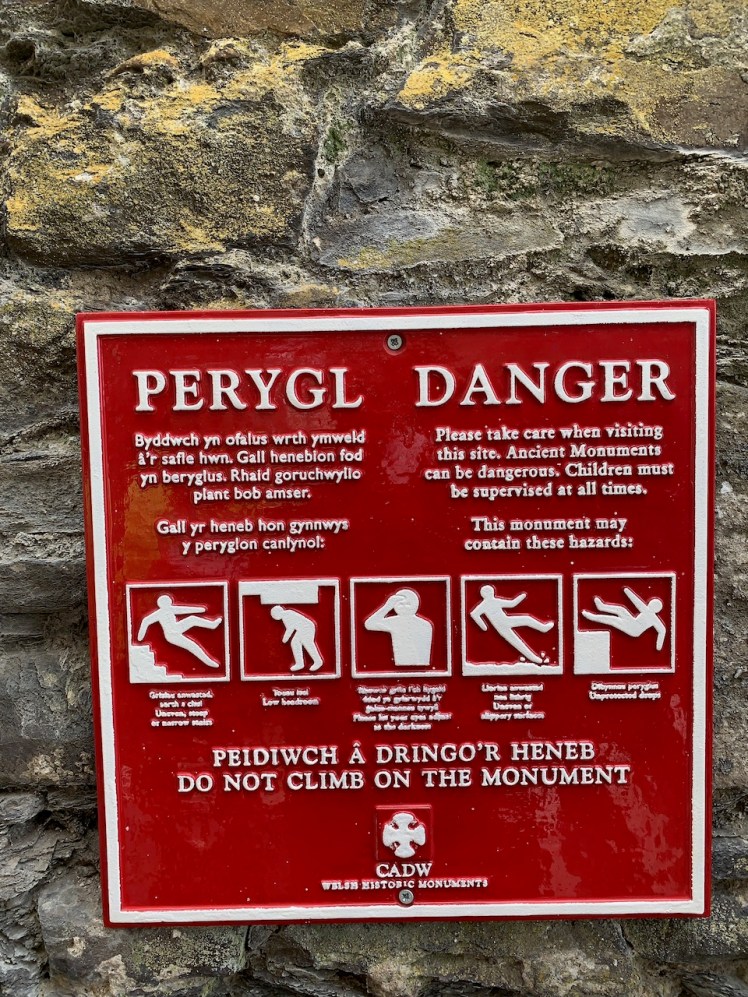
Every sign is in English and Welsh. When you first see written Welsh, at first glance you might think, “Holy consonants, Batman! Someone’s stolen all their vowels!” But in addition to the usual 5 English vowels, “y” is always a vowel, and so is “w.” Plus, Welsh has a bunch of letters represented by two characters (like “dd”, “ll”, and “ch”). Even so, there are some LONG Welsh words with a lot of consonants. We drove through the town of Penrhyndeuraeth (15 letters) but Wales’ longest-named village is Llanfairpwllgwyngyll (@20 letters). That village is sometimes called Llanfairpwllgwyngyllgogerychwyrndrobwllllantysiliogogogoch (58 letters) which translates to “St Mary’s Church in the Hollow of the White Hazel Near to the Rapid Whirlpool of Llantysilio of the Red Cave.” We drove close to Llanfairpwllgwyngyll, but, didn’t know its claim to fame or we would have stopped for a photo. An ex-colleague sent me a link to a weather forecaster pronouncing that village name.

Wales Trip Highlights
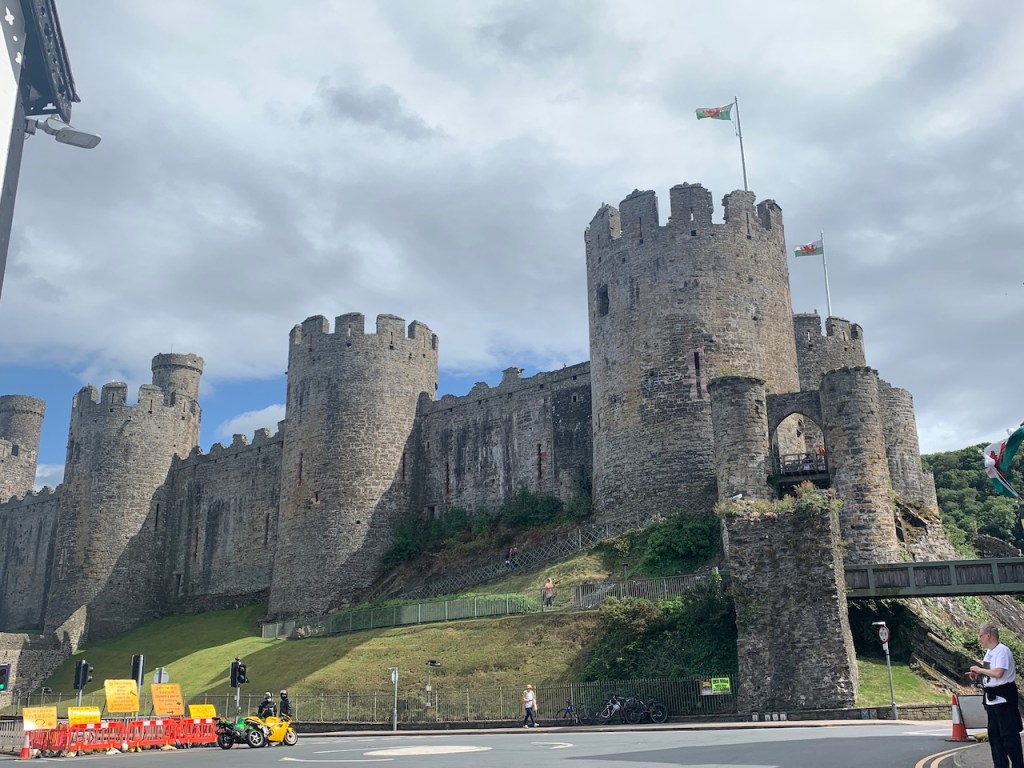
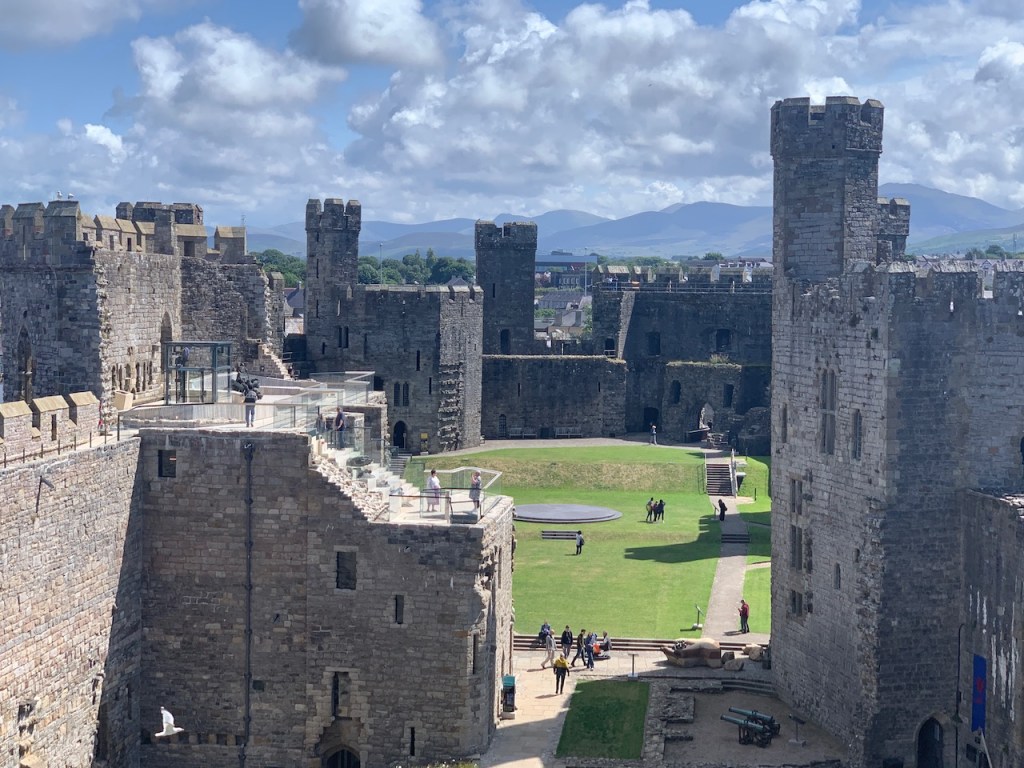
Castles. Castles, Castles, Castles! Holy cow, Wales has fabulous castles! (And over 400 of them.) We tried to fit in at least one castle each day. We actually ODed on castles and skipped the last couple we’d plan to visit. But Wales started off with a bang. Conwy Castle, Beaumaris Castle, and Caernarfon Castle were just awesome. Unlike almost all of the castles we’ve visited in Europe, many of the castles were still fairly intact. The downside of so many standing walls, though, is that if you insist on climbing every tower just in case you can get a better photo op, it’s a shitload of stairs.
- Conwy Castle, a UNESCO and World Heritage Site, is one of four castles built by English King Edward I to reinforce his conquest of Wales. The outer walls, marked by eight enormous defensive towers and two barbicans guarding its gates are almost entirely intact and provide fabulous views of the town and Conwy River. Unlike other castles which require lots of imagination to figure out what’s what, most of the rooms, including the medieval royal chambers, were really well preserved.
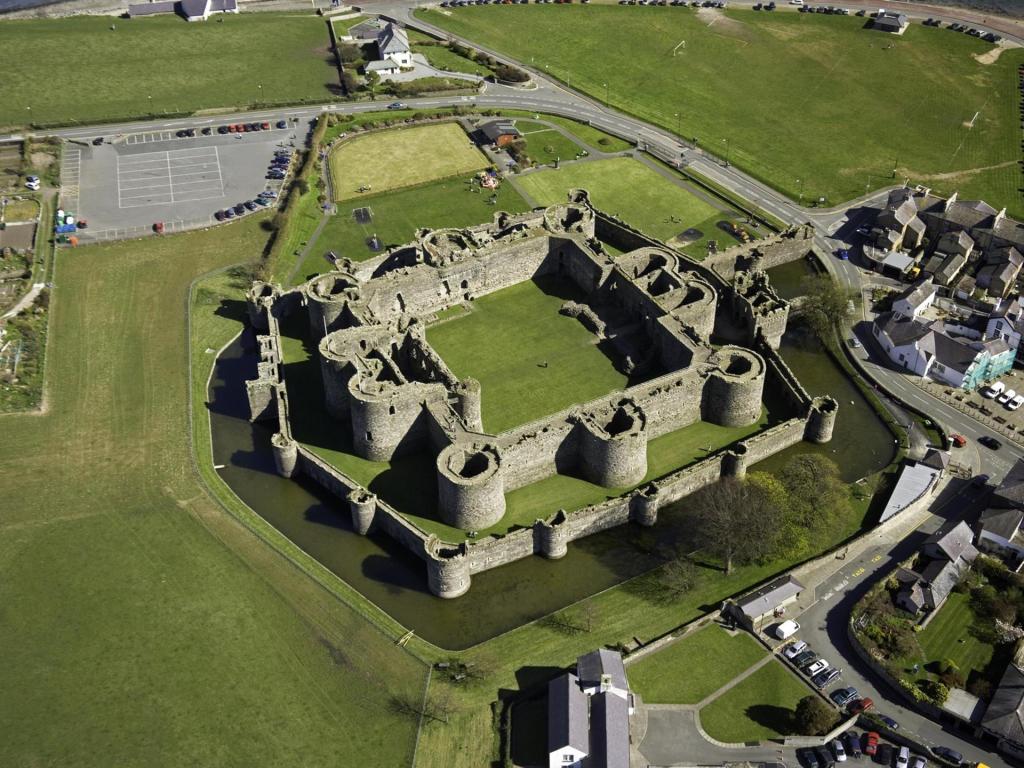
- Beaumris Castle is described as “the greatest castle never built.” The last of Edward I’s defensive castles in Wales, he stopped building to redirect funds to go fight the Scots. This was my favorite castle. It’s a fortress within a fortress. There’s a moat (with water still running in it), a tall defensive wall, and then the castle itself, with lot of defensive towers. I’m including a “borrowed’ overhead photo from the Welsh Cadw site so you can see how cool it is.
- Caernarfon Castle is another of Edward 1’s “screw you, Wales” castles. He made sure his son, Edward II, was born there so he could “legitimately” call him a Prince of Wales. If you’ve been watching The Crown, Charles’ investiture as Prince of Wales happened at Caernarfon. That Caernarfon ceremony only happened one other time (1911). The current Prince of Wales went through the typical bureaucratic process: the king just assigns the title. This castle is huge & intimidating with several really tall towers. My legs started to shake by the time I climbed all the way to the top of the Eagle tower.
- Powis Castle had a rich family living in it until the mid-1950s. Initially a medieval fortress, it’s stuffed to the gills with an internationally renowned collection of paintings, sculpture, furniture and tapestries. The phrase “too much” kept leaping to mind. But we were there for the Clive Museum, which houses Robert Clive’s collection of treasures from India. “Clive of India,” as Joy and I learned in season 1 of the Empire podcast, is the epitome of British Imperialism and one of Britain’s most controversial colonial characters. Via his role in the East India Company (EIC) he was responsible for establishing the British Raj, in which the EIC ruled India in everything but name. There’s a famous painting, mentioned in the podcast, showing the Mughal emperor Shah Alam “gifting” Robert Clive all tax collecting rights to the East India Company. You’re not allowed to take pictures because the rich family still owns all the art, but it’s all online anyway. Even so, if anyone asks, you averted your eyes rather than look at my photo of that painting.

Other Cool stuff
We saw many other interesting sites and had many other great experiences, all of them made that much better by the universally welcoming and generous Welsh people. A few other highlights:
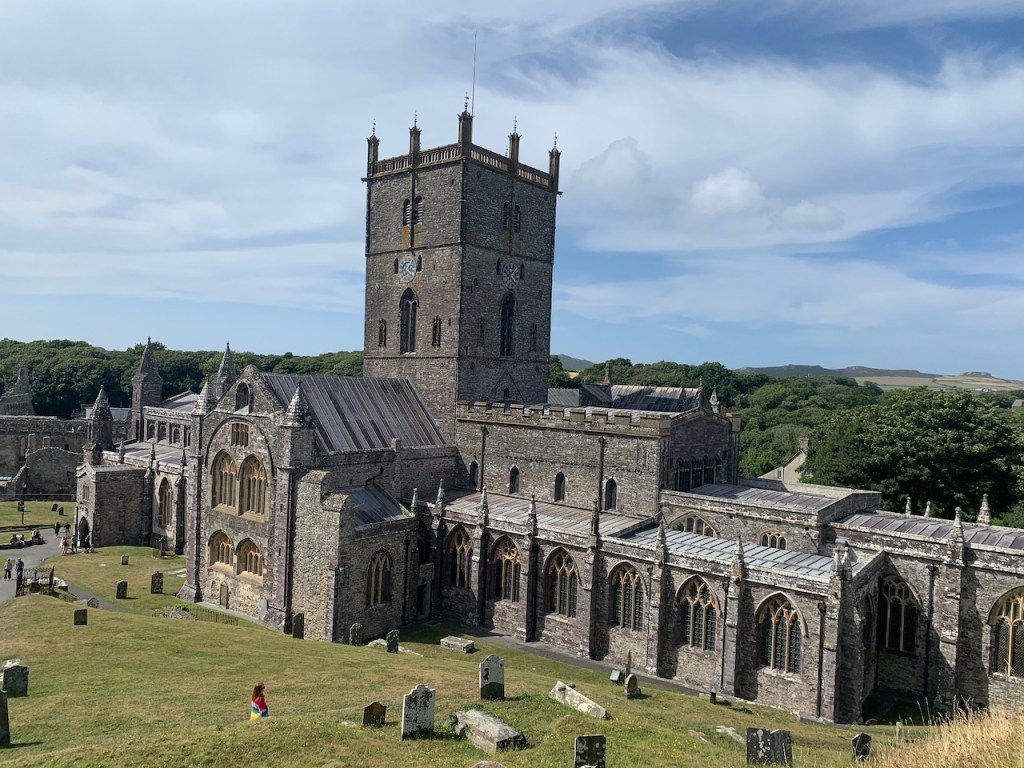
- St David’s Cathedral. This cathedral, home to Wales’ patron saint, was pretty special. Henry VIII didn’t have it crushed so it’s still intact, and beautiful. I also loved that the Cathedral’s first Norman Bishop persuaded the Pope that two pilgrimages to St David’s was the equivalent to visiting Rome. Hence, a lot of money. This guy was brilliant at marketing!
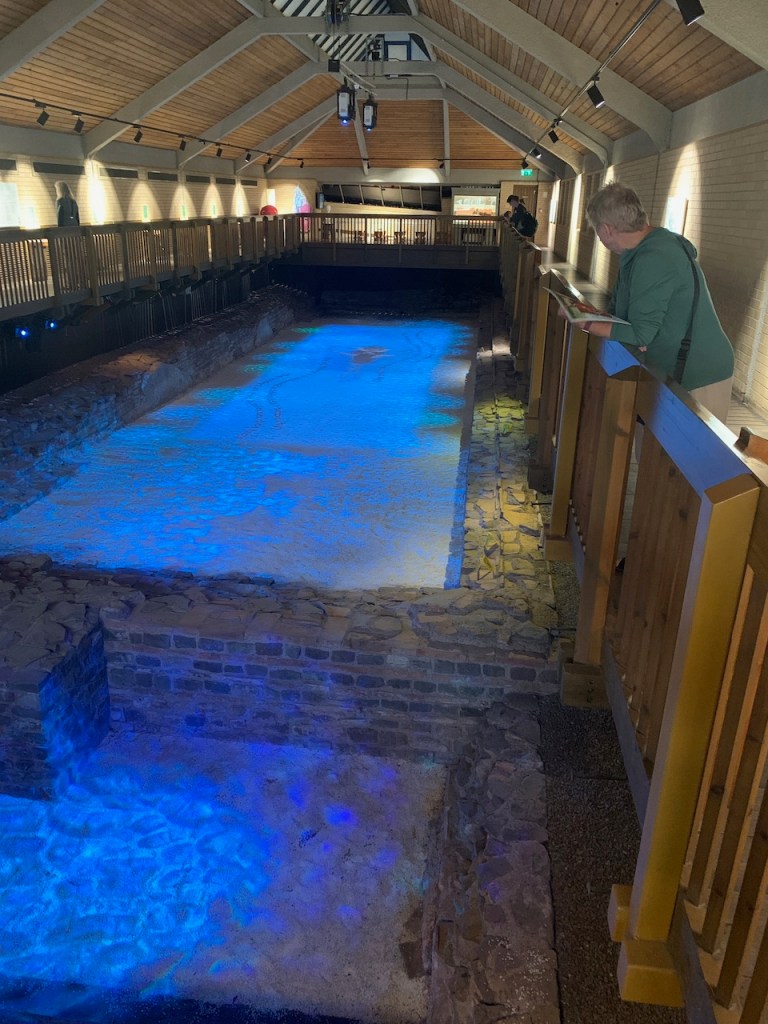
- Roman ruins. Even the Romans had a tough time beating the Welsh. It took them 30 years of trying and they weren’t successful in Southern Wales until 75AD. The Romans built some significant forts to deal with the local Welsh, and the Roman fortress baths in Caerleon (just outside of Cardiff) are impressive. Caerleon also has the best preserved Roman amphitheater in the UK.

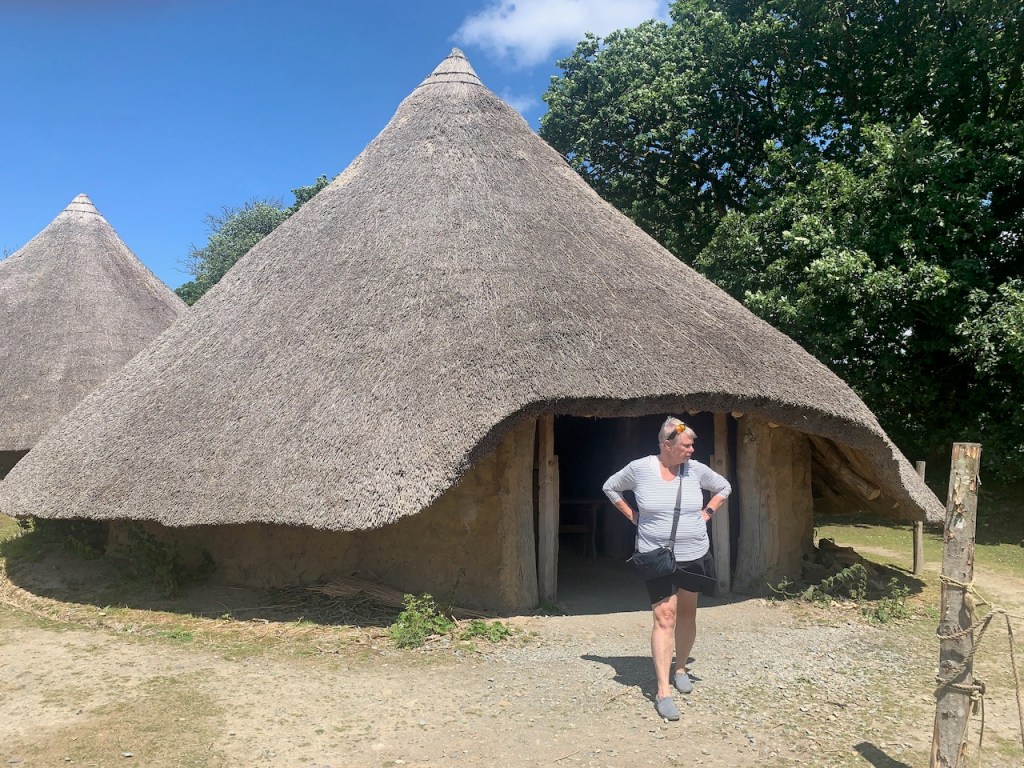
- Really Old Stuff. We also saw a few exceptional Neolithic & Iron Age sites. I was surprised how much I enjoyed visiting Castell Henrys, a small recreated Iron Age built on top of existing ruins. The Bryn Celli Ddu Neolithic site was very cool. The highlight, though, was Pentre Ifan, an impressive gravity-defying Neolithic tomb quarried from local “bluestone” also used to build Stonehenge.
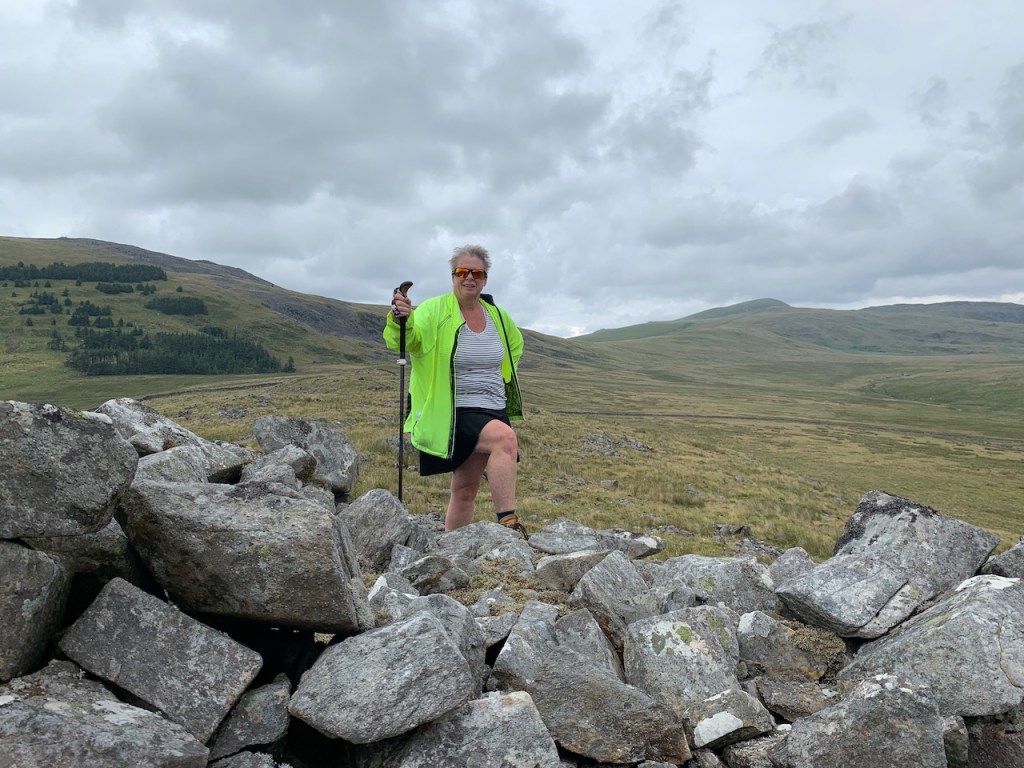
- Snowdonia (Eryri) National Park, home to Wales’ tallest peak (Snowdon) is beautiful. We only had time to do one Eryri walk (see our England post to learn about “walks” in the UK), so naturally, we chose one that included a visit to an Iron Age hill fort (this was just piles of rocks, but still impressive). My big regret is that we didn’t have more time to explore Eryi .


Mini Trip Down Memory Lane
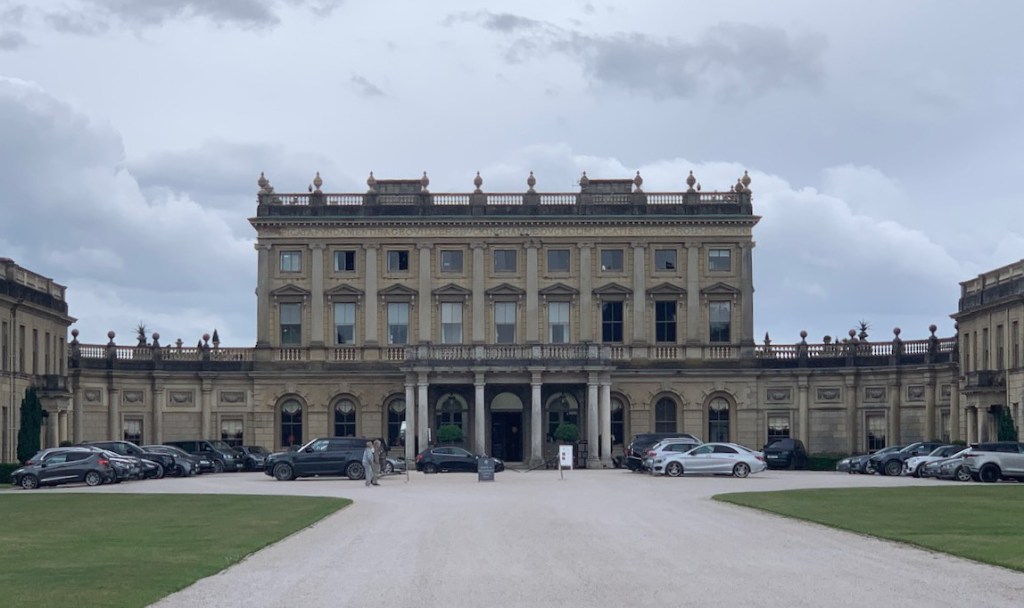
While heading back to London, Joy and I decided to swing by Cliveden House for High Tea. I spent part of my senior year there through Stanford’s Overseas program in England. Cliveden has been the home to a Prince of Wales, two Dukes, an Earl, and the Astors (as in Waldorf & Nancy Astor). Cliveden was where the Prince of Wales (George II’s eldest son) was hit in the chest with a cricket ball that caused a fatal infection. (His son went on to be George III.) When the Astors were there, it was the 1920s & 30s hangout for the “Cliveden Set”—a group of political intellectuals. It’s now a 5-star hotel. We thought about spending a night there, but decided £1,500/night for a room in the main house was a bit too rich.
Running 11 Month Travel Totals To Date:
I’m only counting stats up until we left England for Greece in mid-July. 7 months into our 11 month trip we have been in (though Joy missed out on Mexico):
- US States: 7 Oregon, California, Arizona, New Mexico, Texas, Louisiana, Mississippi
- Countries: 11 US, Mexico*, Cuba, The Netherlands, France, Switzerland, Germany, Austria, England, Kenya, Wales
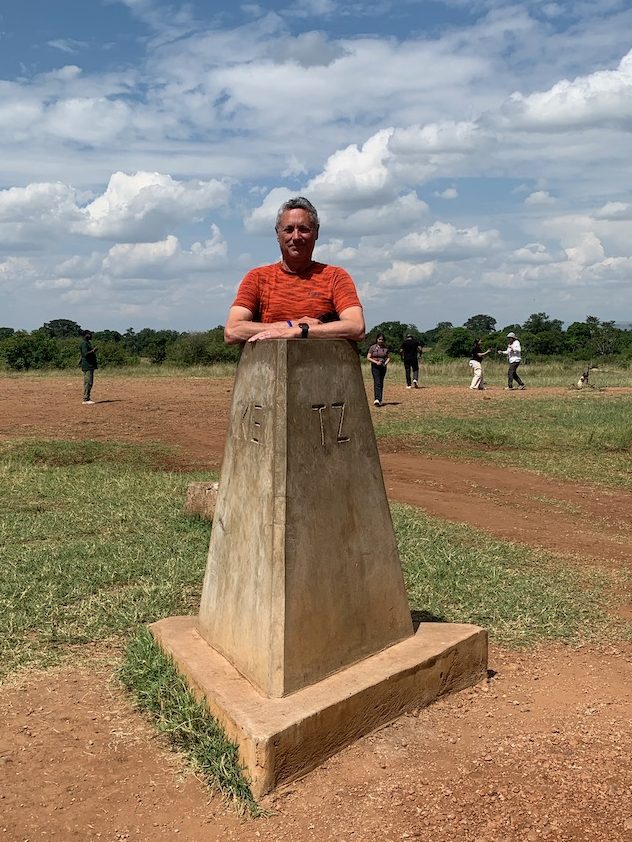
- plus 2 additional sort-of country visits for Tony: Guatemala when the Mexican boat momentarily crossed onto the Guatemala side of the river, and Tanzania when Tony walked across the Kenya/Tanzania border for a photo (below).
- Continents: 3: North America, Europe, Africa
- Different beds: we’ve slept in 83 different beds (91 if you include same hotel/house but different rooms each visit), which averages to a different bed either every 2.4 or 2.2 days.
 Itinerant Philosopher
gre
LikeLike
The precursor to the Welsh language ~500ad was British which was spoken all across England and Wales. My impression is that the Welsh see themselves as “British” and the English as a hoard of Franks, Germans, and Vikings who come for the weekend and never bothered to leave. The English powers-that-be have tried to justify their legitimacy by waging war, building forts, having their children in Wales, investing the British heir, and intermarriage with the Welsh going both directions (the Tudors are Welsh), and etc. It may all depend on how you pronounce “British”. This is a whole year of enthusiastic adult ed Welsh lessons speaking.🏴
LikeLike
MaryEllen, Thanks! Your’s would be a much more educated opinion than what I came up with over the course of 10 days.
LikeLike