
Joy and I spent late October/early November cycling in Portugal’s Azores islands and then headed to Cappadocia, Türkiye (Turkey) to do even tougher cycling. Why those two places? In August our friend, Aydin, invited us to join an Eon Tour (his Türkiye-based tour company) end-of-season cycling tour for employees, cycling from Cappadocia to Antalya. We love Türkiye, we love Eon Tours, and we love Aydin, so we were thrilled to be invited. The Azores was a happy surprise.
Azores was hub & spoke cycling, returning to our same hotel each night. And we were on small islands so we cycled in big circles. Turkey was mostly cycle touring, moving from one city to the next. While we cycled on our own in the Azores, in Turkey, there were 22 of us, and we had van support. Türkiye is steeped in history. The Azores are just plain steep.
We’ve written about Türkiye-based adventures before, so I’ll focus more on describing the Azores.
The Azores
While researching flights to Türkiye, Joy stumbled across inexpensive business class flights from Boston to Lisbon, via the Azores. The Azores? (The accent is on the second syllable, btw.) I kinda knew where the Azores are (somewhere in the Atlantic). And I only knew this because of those fun Indiana Jones movie maps that show Indy traveling to his next exotic destination in short hops. Turns out the Azores archipelago, which belongs to Portugal, is ~900 miles west of Portugal and ~2,000 miles east of Boston. So not quite in the middle of the Atlantic, but far, far away from anything else. These inexpensive Portugal airlines flights are designed to entice North Americans to visit Portugal during the offseason. We were enticed. Staying in the Azores for ~10 days would not only break up the long set of flights between San Francisco and Cappadocia, it also meant we could adjust to the 11 hour California-Türkiye time difference in a 7 hour chunk and then ten days later, another four hour chunk. Besides, who do you know (besides us, Mark Twain, and Indiana Jones) who’s been to the Azores? We had to go.
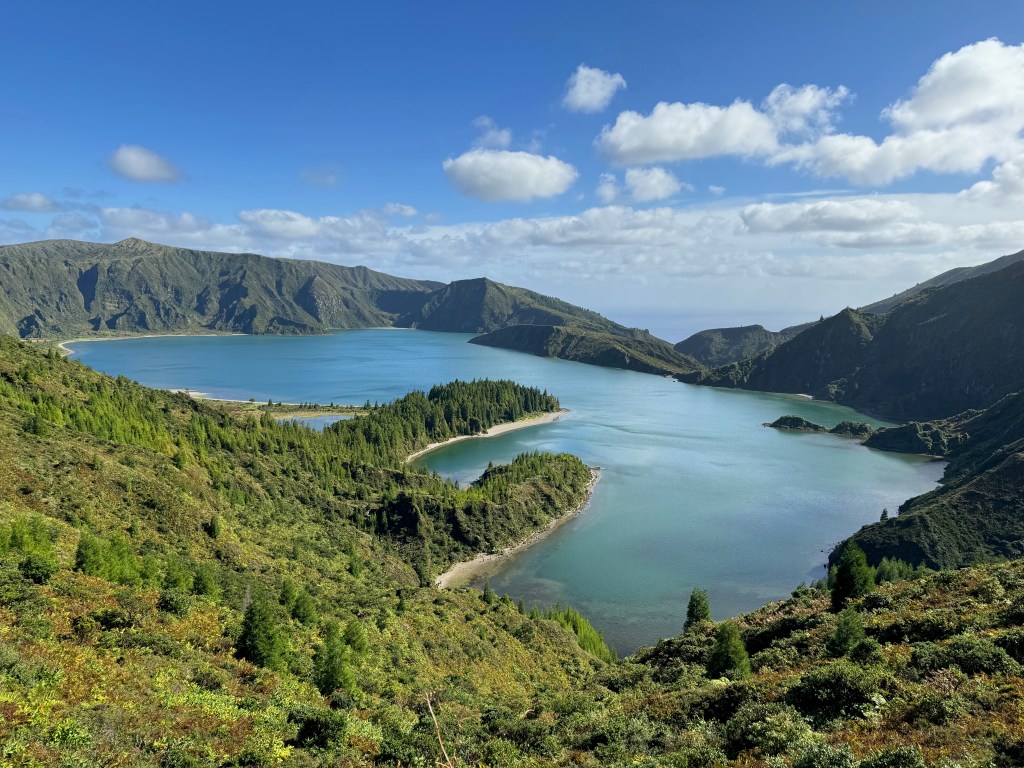


Since your lack knowledge of the Azores likely rivals mine, here is a quick set of facts/observations.
- The Azores archipelago of 9 volcanic islands is the result of three tectonic plates (North American, African, and Eurasian) pulling apart from each other at this exact spot in the Atlantic, causing all sorts of geological excitement. A mish-mash of repeated, overlapping volcanic eruptions and continental uplift leaves the islands with tons of volcanos, calderas, lava flows, and exposed cool-looking rock formations to explore and marvel at. Once again, I lament my lack of geology knowledge.
- The Portuguese claim they discovered the Azores in the early 1400s, though many (non-Portuguese) agree that claim is political pretention. There is some evidence that other mariners (like the Vikings) lived there for a short time around 750AD. Putting aside who got there first, by the time the Portuguese began settling the islands, there was no one living there and no obvious signs of habitation. Even today, the Azores are thinly populated. Across all nine islands there are roughly 250,000 people, and more than half of them live in Ponta Delgada (the Azorean capital) on São Miguel.
- The Azores eventually become an important pit stop for ships sailing the Atlantic between Europe and the Americas. Now, it’s a nice pit stop for folks crossing the Atlantic by plane.
- Because of the Gulf Stream, the Azores archipelago has a moderate climate all year round. According to Mr Wikipedia, “Daily maximum temperatures at low altitudes usually range between 16 and 25 °C (61 and 77 °F). … neither Ponta Delgada nor Angra do Heroísmo, the two largest cities, have ever been warmer than 30 °C (86 °F). There has never been a frost, snowfall, freeze or even temperatures below 5 °C (41 °F)” This sounds great, except for that pesky humidity factor, which is often like 80%.
- The Azores were a key part of Portugal’s whaling industry but now they’re a great whale watching destination. And a great diving spot. Besides vibrant marine life, thanks to naval battles and tricky natural obstacles to navigate, there are also hundreds of sunken ships to explore.
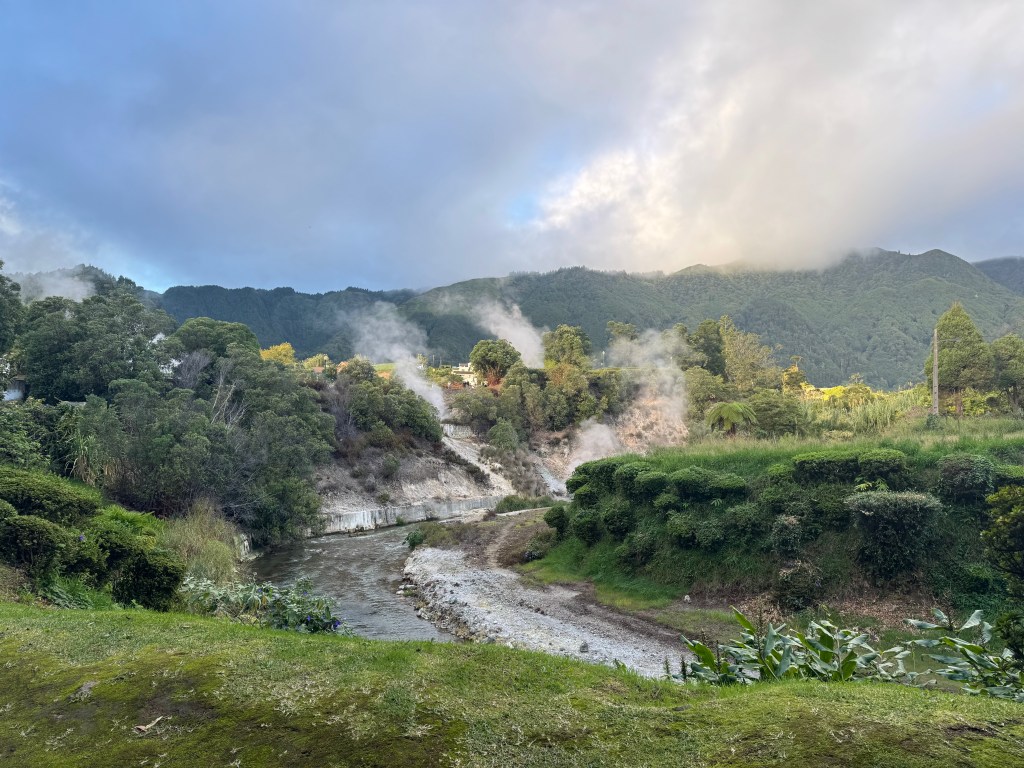
We started (and ended) our Azores adventure on São Miguel, the largest of the islands and used Ponta Delgada as our base for the first few days. We then flew to the island of Terceira for a few days before returning to the Furnas area of São Miguel for our last few days. Furnas is particularly interesting because it’s where the island’s volcanic nature is most on display. There are over thirty springs and geysers dotted around the village, some of them used as geothermal swimming pools and others (the hotter ones) used for cooking. Our hotel’s indoor and outdoor pools were both geothermally heated, and they felt great as those last few days turned cold and rainy.
On the island of Terceira (population: 50,000) we had arranged for an all-day guide who drove us all over the island to visit various interesting sites. Over 20% of the island is designated as natural park zones, and it was a nice change from Ponta Delgada and its 130,000 locals. At just over 150 square miles, we were able to crisscross the entire island and see most of the highlights in just one day! Sadly, “Christmas Cave”, which is supposed to be pretty cool, was closed.
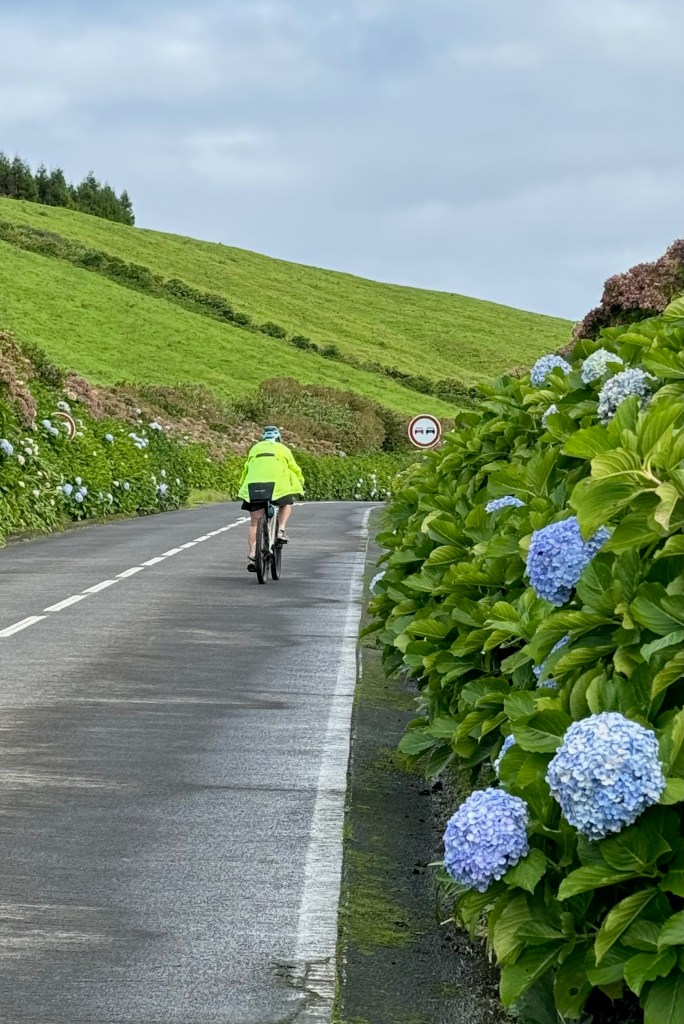
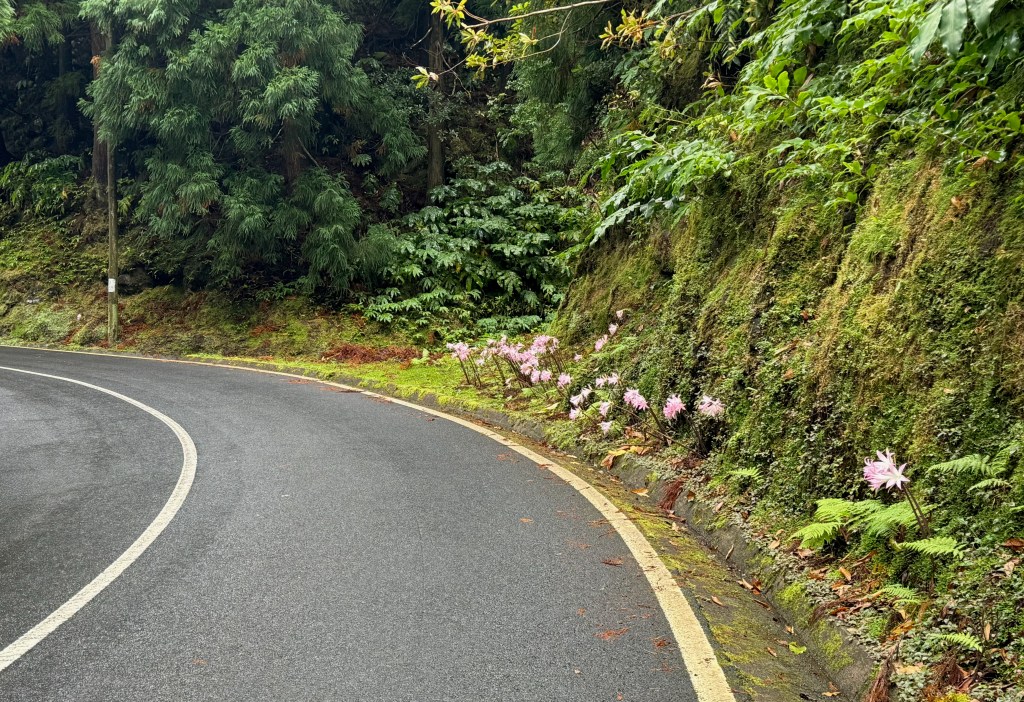
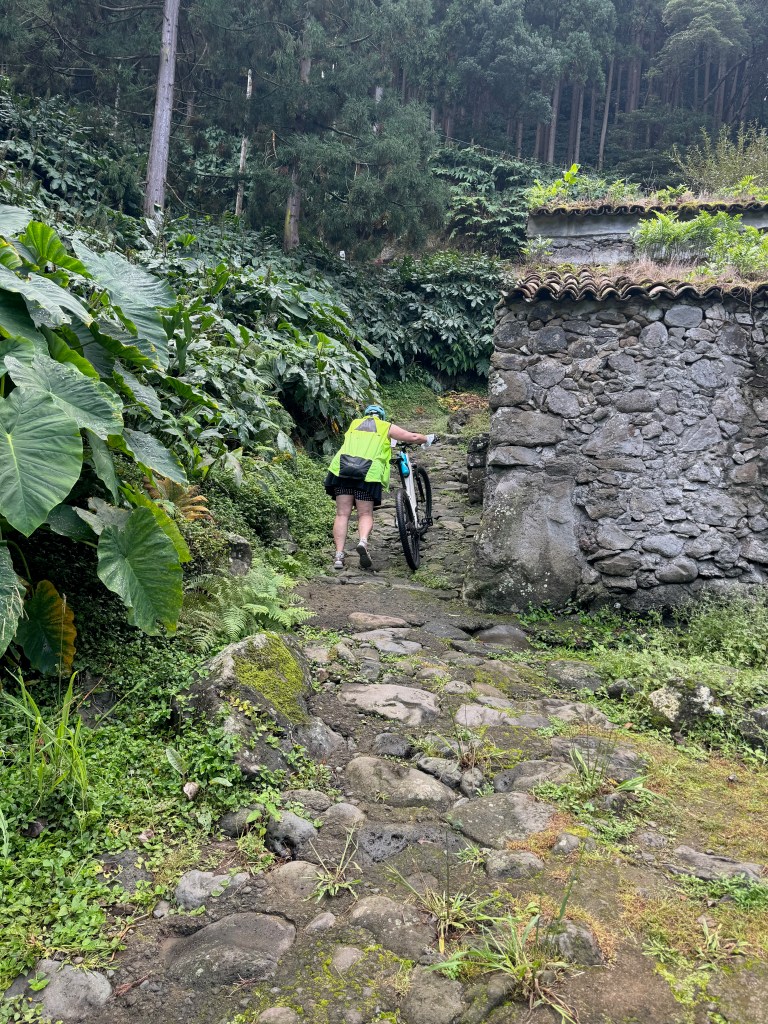
The two islands we visited were a lush mixture of wide-open vistas of patchwork farms and fields bordered by lava stone walls and hedgerows, or dense forests of orderly Japanese cedars destined for lumberyards, or steep caldera walls awash in dense green foliage and bright flowers. Beautiful to tourists, and to the chagrin of locals, invasive, non-native hydrangeas are everywhere. Many of the roads we cycled were lined on either side with densely packed walls of hydrangeas. They were well past their bloom cycle, but we saw enough remaining blue flowers to imagine what the islands must look like in June and July when they’re in their full glory. Where hydrangeas haven’t taken over, wild ginger has, and we often cycled past walls of wild ginger growing up steep canyon walls. We also cycled past lots & lots of groups of Naked Ladies standing proudly along our routes. If I were referring to townswomen rather than flowers, I would have cycled past those sections several times. But, alas… On the other hand, If I ever open a restaurant, I’m going to call it “Naked Ladies & Wild Ginger.”
On the island of Terceira, they practice a weird version of Portuguese bullfighting: the “tourada à corda” (bullfight on a rope). A bull is tied to a long rope and bunch of men hold onto the other end to try to keep it under control while “volunteers” jump in front of the bull, getting as close as possible and hoping not to end the day in the hospital. After 30 minutes of trying to gore villagers, the bull is swapped out and a new bull gets its turn to maim participants. These events go on for hours. “Used” bulls are sidelined for a few days before they participate in a tourada again. Bulls participate a lot. Tourada season goes on for months since every village and hamlet hosts a multi-day tourada. Did I mention that the Azoreans drink a lot? Plus, they live on a small island in the middle of the Atlantic with not much to do besides farming, so it’s not too hard to imagine how this weird festival came to be. Neither of us was disappointed that we’d missed the bull fighting season.
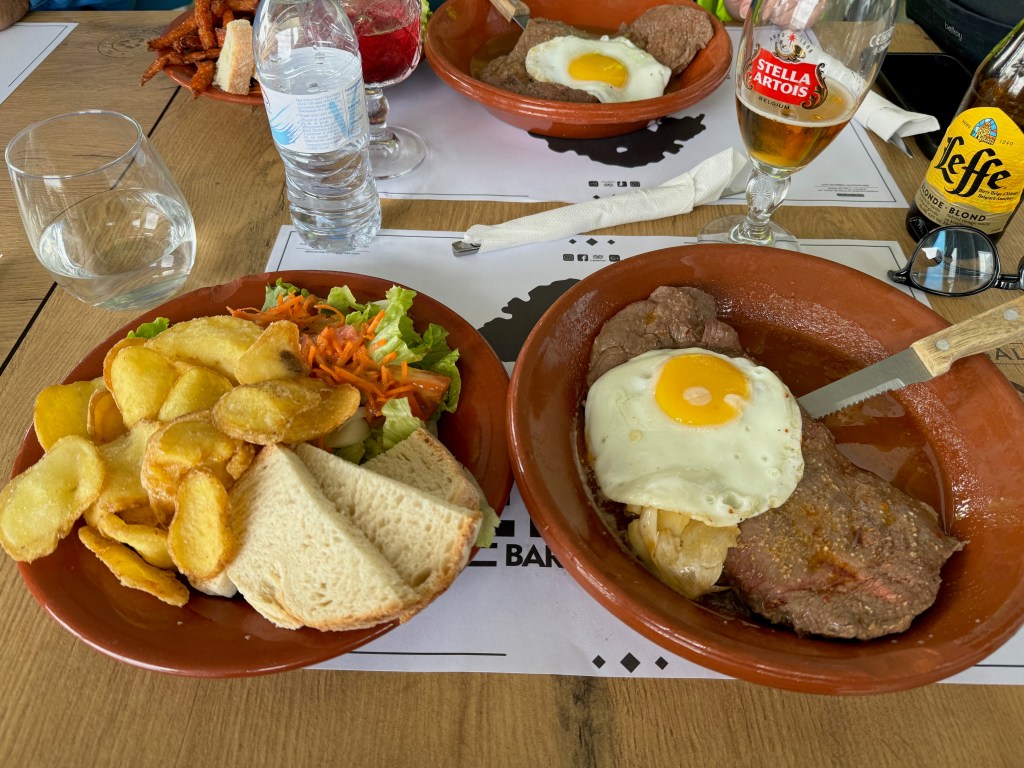
Being islands in the middle of the Atlantic, Azorean cuisine would surely be seafood focused. Wrong. Oddly enough, the Azoreans love meat. I mean, they love meat. Non-hotel restaurants had pretty sparse alternatives to red meat. And while we had a few good meals (I have fond memories of a garlic shrimp platter in Furnas), the Azores travel guide book was more accurate than we would have preferred.
“Sadly, it cannot truthfully be claimed that the islands are a gastronomic delight… usually dishes are simply prepared, and a rich accompanying sauce would be a rare find. Azoreans have fairly conservative tastes, which results in the appearance of potatoes and rice, plus a huge basket of bread. …Many Azoreans admit there is often a focus on quantity rather than sophistication and you will surely never be underfed there.”
The travel company that arranged our Azorean adventures provided us with a list of suggested restaurants that included the following comment:
‘São Miguel’s most famous dish is Cozido – a meat stew which is slow-cooked in the hot volcanic ground on the shores of Lagoa do Furnas. It’s not my favourite Azorean dish if I’m honest – it often feels more like a meat-eater’s endurance challenge than an enjoyable meal. If you are planning to eat a cozido for dinner, my advice is to skip lunch (and probably breakfast).”
Furnas was our final destination in the Azores. By the time we got there, the idea of eating a cozido was highly unappealing. We did see the volcanic steam vents where restaurants cook cozidos, though.
Türkiye
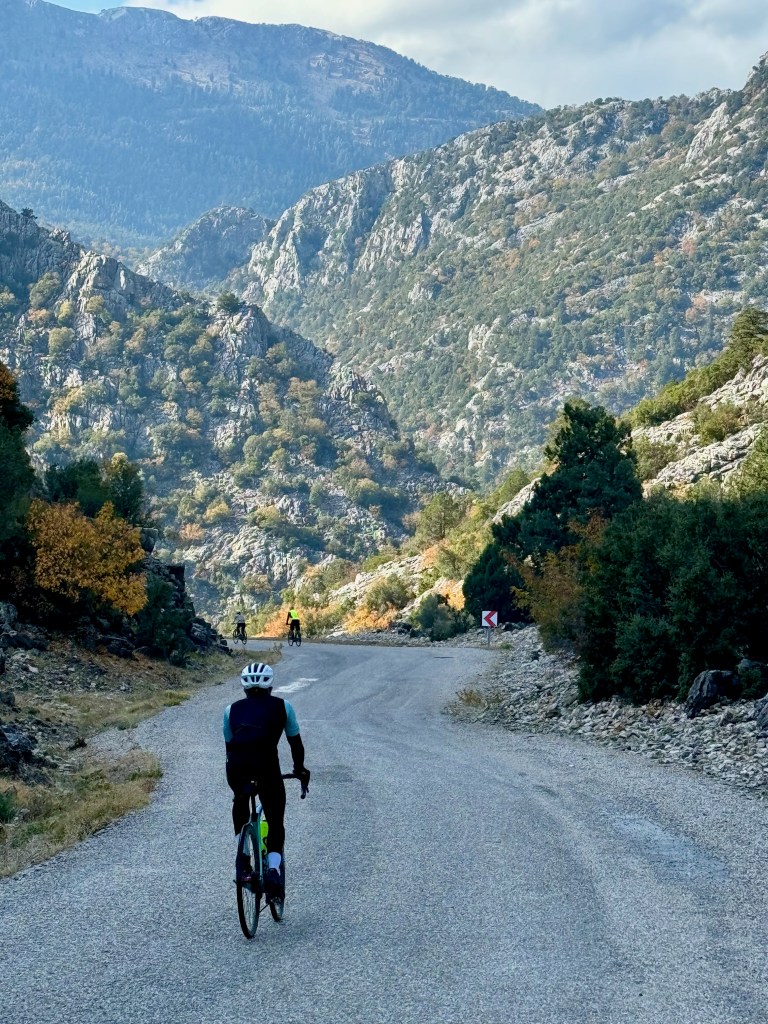
We considered the Azores warm-up cycling for Türkiye, where the cycling was serious. I cycled just over 300 miles over six cycling days, about 50 miles less than originally planned, partly because I bailed out of the last part of a ride when it started to rain. And twice we had to stop riding and jump in the sag wagon when dusk hit, a casualty of our late morning starts. Joy left a day early to teach a class in Amsterdam, so she missed a day of cycling. Our longest ride was 63 miles (almost exactly 100KM). If we’d done all the cycling, we would have climbed *just* shy of 25,000 feet in 6 days, but I hit 22,600.
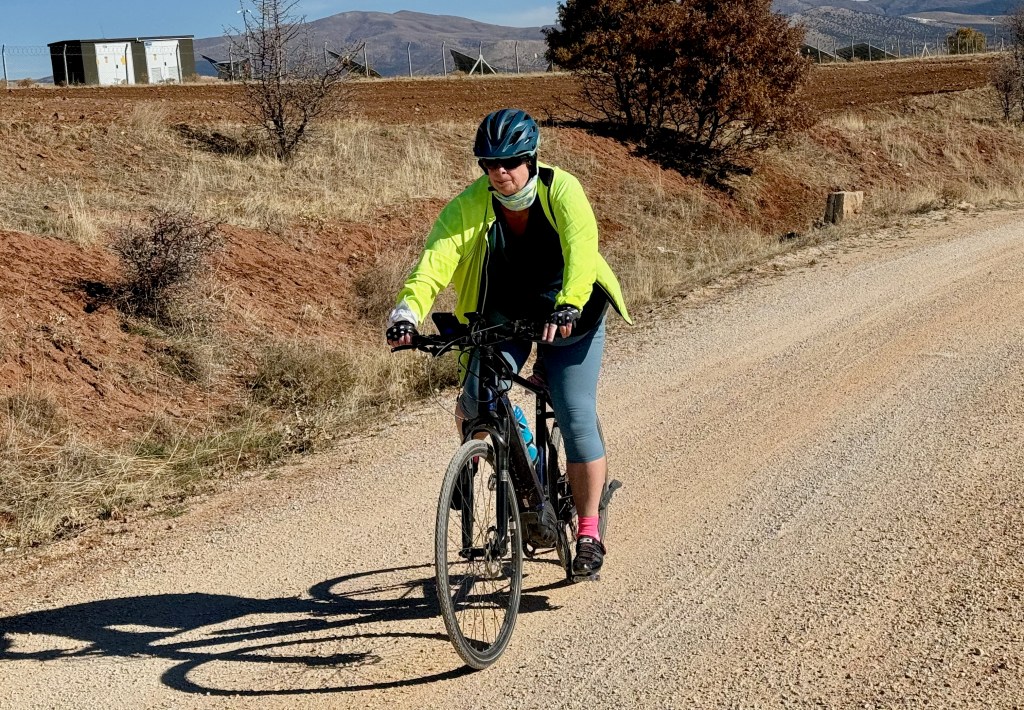
Of the 22 of us on the trip, almost exactly half of us were on e-bikes (Joy & I were). The others were on road bikes. Of course, almost all of those riders are in their late 20’s and early 30’s, and they lead cycle tours for a living. No way was I keeping up with them!
Because we’d be cycling in November we expected Cappadocia (which is far inland and at elevation) to be coldish and potentially rainy. It wasn’t particularly rainy, but it was unseasonably cold. Every day we started cycling an hour or two later than originally planned because none us of wanted to start cycling when it was below freezing. It was usually in the low 40’s when we’d saddle up. Have I mentioned before how much I hate cycling in the cold? If not, I freakin’ hate cycling in the cold. Usually, I was wearing a Nike technical exercise t-shirt (sometimes a long-sleeve version), over that I had a cycling shirt (those tight fitting shirts with the 3 pockets in the back), and then my long-sleeve cycling jacket. I was also wearing full-fingered cycling gloves, thick socks rather than cycling socks, cycle leggings, shorts over my cycling chamois (those padded lycra shorts cyclists wear), a beanie under my helmet, and a neck gaiter. And I was exercising for hours. I was still cold.
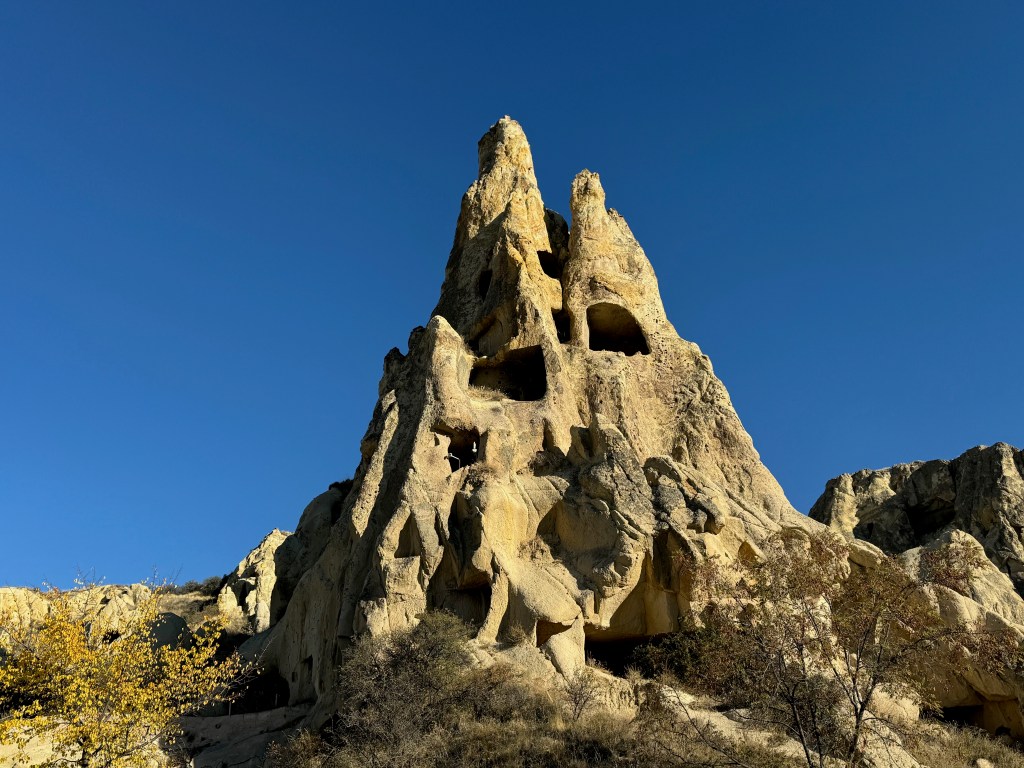
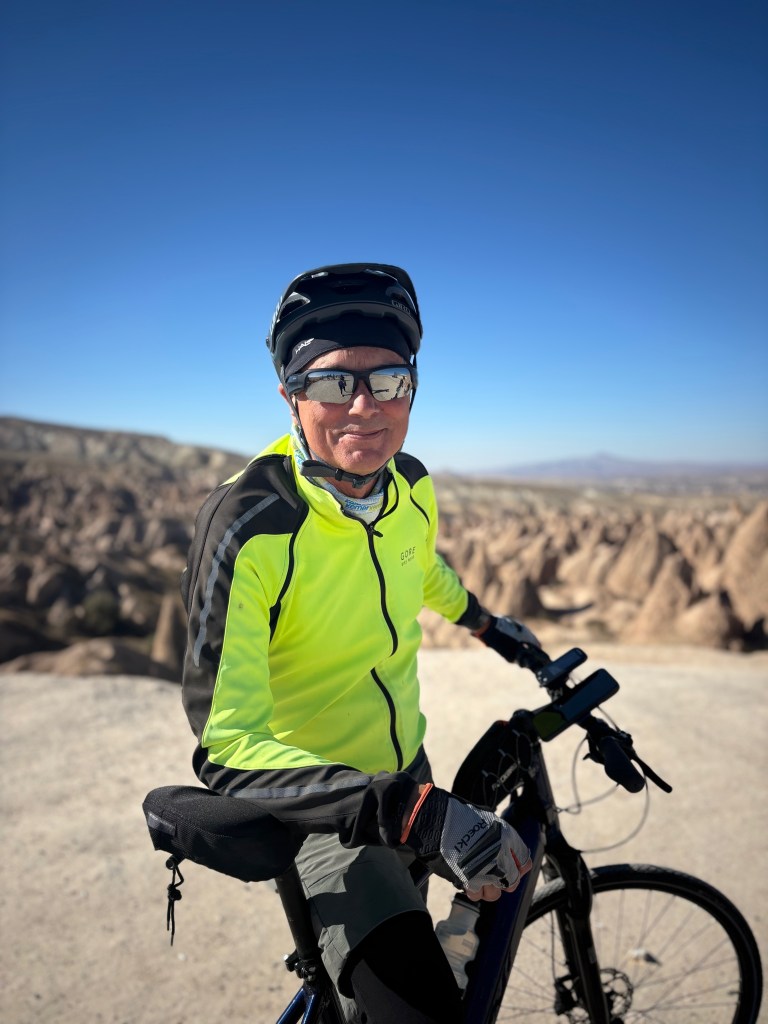
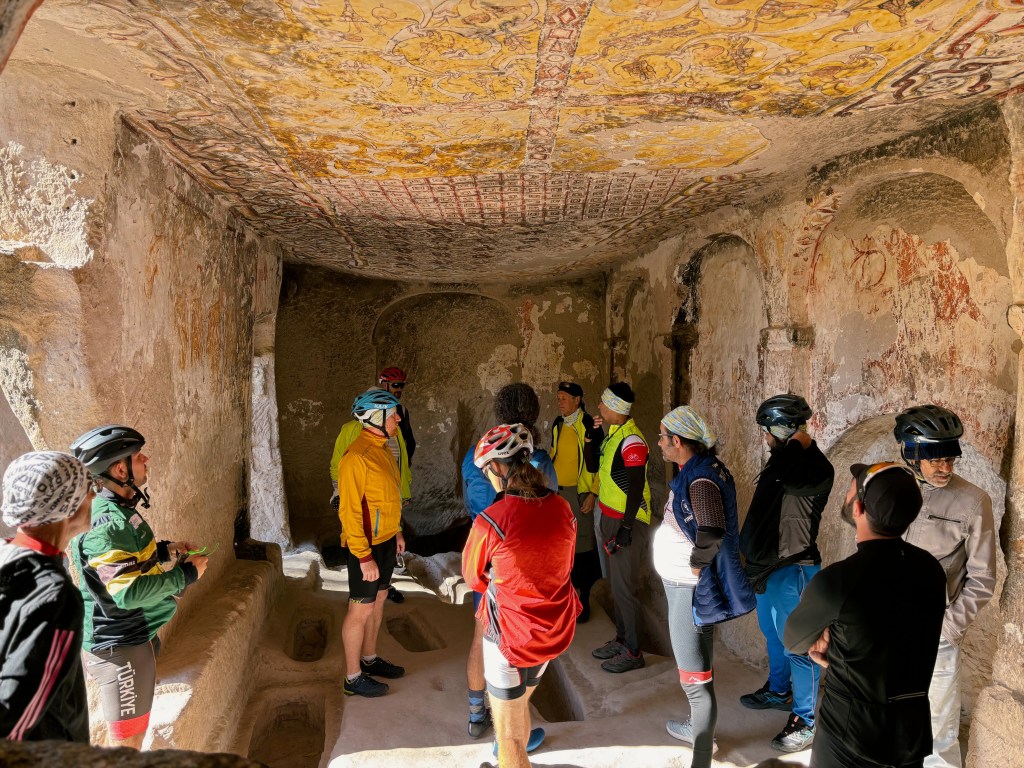
Almost all our cycling days included extended stops to visit archaeological sites, open air museums, underground cities, or short hikes. Even though we’d been to the Göreme Open Air Museum twice before, I still enjoyed wandering through the eroded rock formations hollowed out in the Middle Ages to create Christian churches, houses, and underground cities. Some of the earliest man-made caves and tunnels date back to the second century when ascetic monks adopted a troglodyte hermit lifestyle and created rock-cut churches adorned with simple paintings, and later, frescoes.

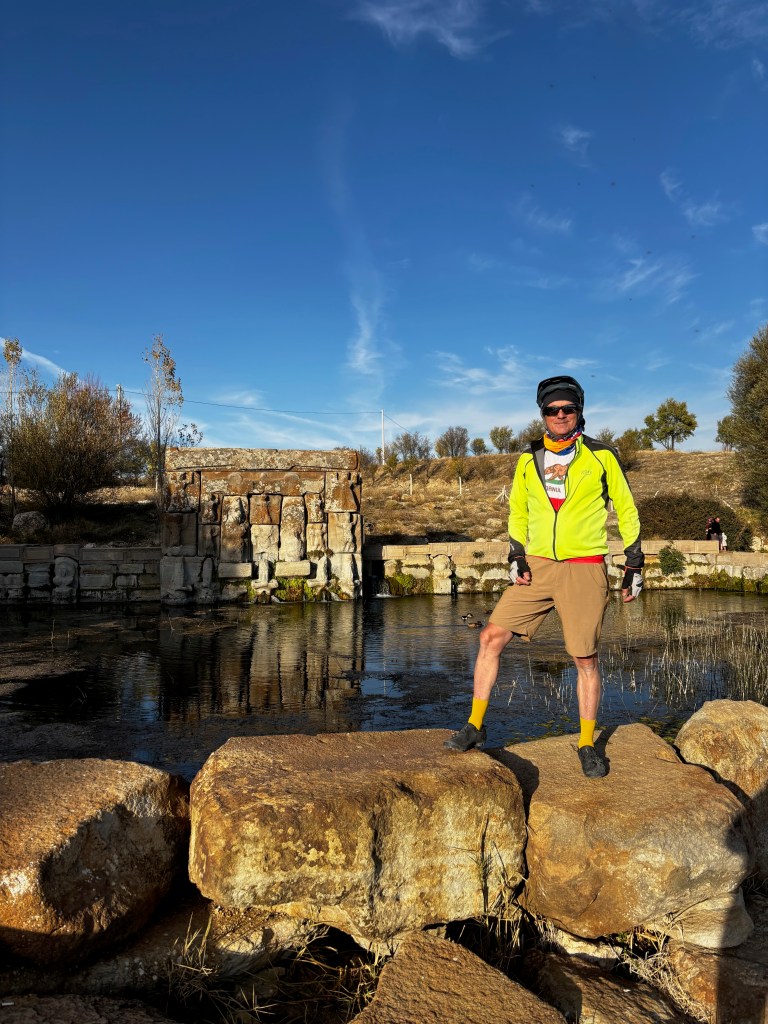
At the end of the trip we visited the coastal town of Side. Joy’s early departure meant she missed this “side trip.” (Her joke.) Side, like most of Türkiye has layers upon layers of history. The city was likely founded in the 7th century BCE by Greek settlers, then visited by Neo-Hittites, controlled by Alexander the Great in 300BCE, conquered by Rhodes in 190BCE when they defeated Hannibal (who was presumably elephant-less at the time), and then taken over by the Romans around 70BCE. That got us to the “current era”. 1,400 more years before the Azores got interesting.
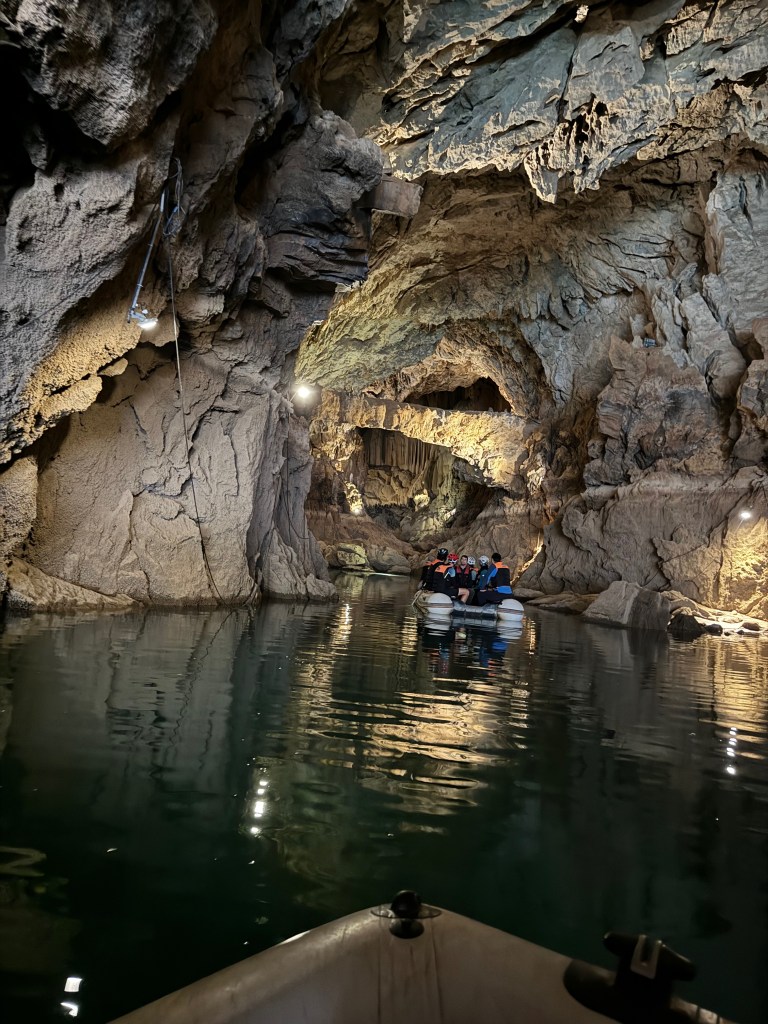
One day our cycling took us to Altnbesik Cave, where we took a raft tour on the 5th largest underground lake in the world. Another day was dedicated to hiking along the oh-so-beautiful 16km long Ihlara Gorge, created by volcanic & other geological excitement, as well as the Melendiz River, which we crossed back and forth several times. That whole canyon, volcanic walls 300-500 feet high is some areas, is honeycombed with rock-cut underground dwellings and the requisite 100+ Byzantine churches.
One of the interesting things about these Byzantine Churches and monasteries is that they were created and used by Greek monks, so there’s a lot of Greek writing in the frescos and carvings. Sadly, most of the frescos are destroyed, partly by time and the elements, but mostly by people. The Byzantine Empire went through a ~100 year period, beginning in 726AD when proponents against the veneration of icons (the Byzantine Iconoclasm period) resulted in iconoclasts chipping off the faces in frescoes and statues. (And that’s how we got the word “defacing.”) The wave of Islam that flowed into Turkey several hundred years later brought another set of people opposed to images. Today, of course, folks are using pen knives and felt pens to further mar what remains. Fortunately, images way high up in the ceilings remain fairly intact.
In contrast to the Azores, eating in Türkiye is a gastronomic delight, which was great because we were burning a lot of calories and eating like it. Türkiye has a rich & diverse cuisine that reflects its long history of cultures passing through from Europe, the middle east, and Asia, and blending with local cooking. Turkish dishes take great advantage of bountiful fresh fruits and vegetables, complex use of spices to highlight grilled lamb, beef, and chicken dishes, and oh-so-good yogurt & humus. Once we got close to Antalya and the coast, we had great seafood options. As always, each meal began with a regional twist of local mezes (a selection of small dishes served as appetizers that would be a meal if you stopped there). If you’re not familiar with Turkish cuisine, as some friends say, “Think Greek food. But better.”
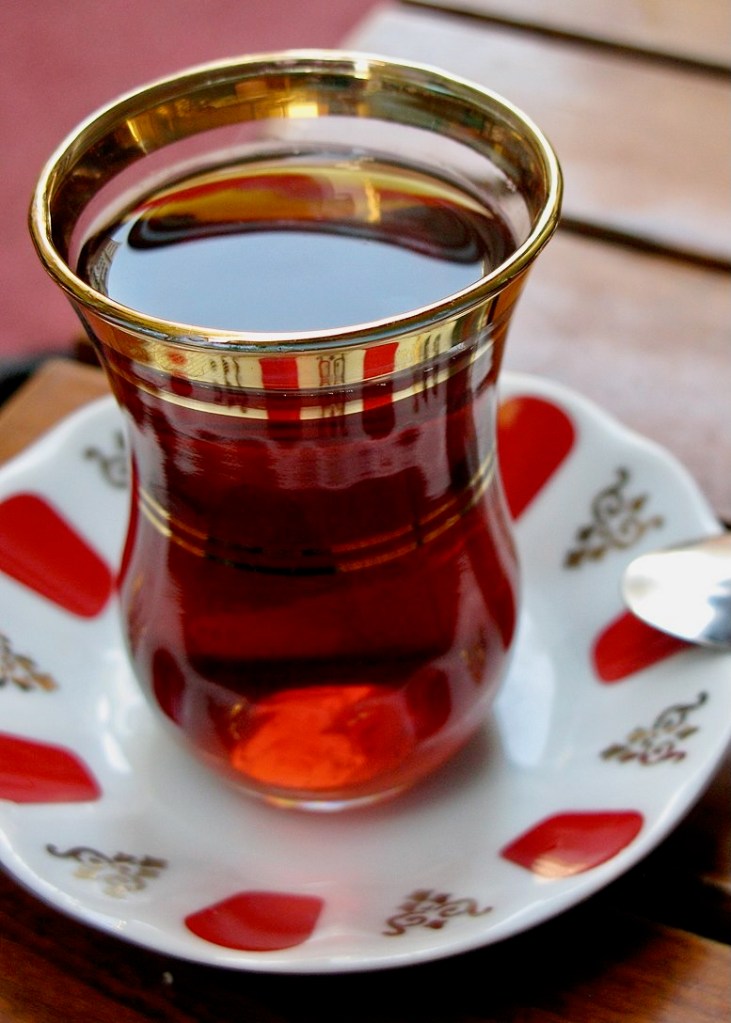
Çay (tea) is an important part of Turkish culture, and they drink a lot of it, and often. Turks drink more çay, per capita, than any other country (yes, even India, China, and England) at ~7lbs/ per person per year. That’s about 1,740 cups per year (four to five cups a day), except that Turks serve çay in tiny little clear glasses, which helps make sure it’s hot. So they probably drink about 5,000 of those per year. I tried to keep up with our Turk cycling friends, being extra motivated by the cold weather. I couldn’t keep up. Of course, drinking all that çay meant I had to stop cycling several times each day to “explore an interesting off-the-road photo opportunity.” Inevitably, those moments overlapped with a flyover by the Eon Tours drone recording video.

Some cycling videos
I am using a new application: Relive, which takes the GPS data from the ride-tracking application on my phone (in this case, RideWithGPS) and creates a video of our rides, capturing our exact route, speed, etc. Each of these videos is about 90 seconds long, so not a major commitment. Two notes about the videos:
- A pop-up window suggesting you create a Relive account may pop up. Just close that window/ignore it.
- The videos have music, but for some reason, they often start in “mute” mode.
- Be sure to watch the elevation gain graphic at the top-left of the videos to see how steep the rides are.
I’ve listed one Azores ride and one Türkiye ride below, so you can get a sense of each part of the trip. If you really want to see all ten our rides, check out: https://www.relive.cc/profile/yurtilan and click into the Azores & Türkiye collections at the top of the page.
A Good Joke Gone to Waste
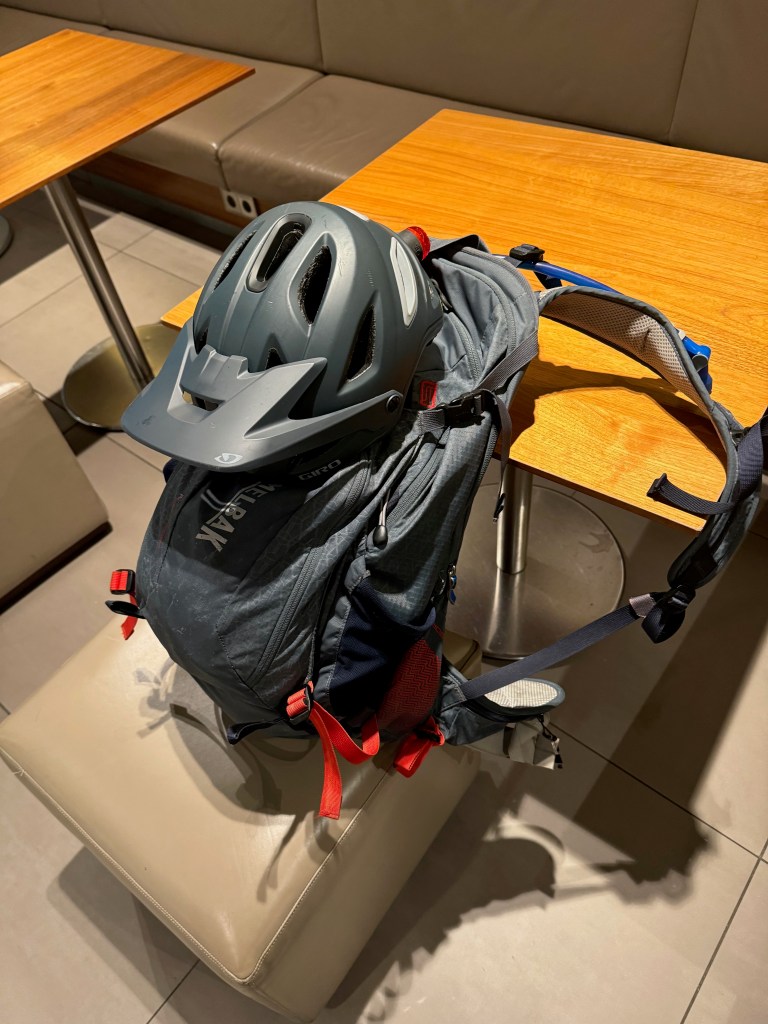
We obviously brought our cycling clothes, including our cycling shoes, with us. We also brought Joy’s saddle (because, you know, “lady parts”), as well as our own helmets. We could stuff everything into our small suitcases except for our helmets, which would take up a lot of room. Instead, we carabinered our helmets to our carry-ons. Walking around airports with a helmet dangling from your backpack is pretty conspicuous, so I expected to get some sort of lame jokes about cycling vs flying. No one said anything, which bummed me out because I was all prepared to respond, “Actually, I’m just really afraid of air turbulence.” Ah, well.
 Itinerant Philosopher
Lovely article folks! Did you know my grandmother’s side of the fam is from the Azores? My great-grandfather travelled there regularly. I always wanted to go! So glad you had a great trip.Much love!
LikeLike
I love living vicariously through you two! I was supposed to st
LikeLike
Hi Tony,
Loved this blog about the Azores… Just getting to read it. Slammed as usual at work and finishing Xmas projects. Hope you and Joy are doing well in CA.
Cheers,
Glynn
LikeLike