
In August we reached out to our friend Aydin (owner of Eon Travel) for help training for our mid-October stint along the Camino de Santiago in Spain. By the time we’d be staring our 75 mile Spanish walking tour, it would be five months since we’d finished our 1,000 mile cycle tour across Europe and any muscle tone and stamina we’d built up would be long gone. We had nearly three unplanned weeks between the end of our Greek sailing trip (see Joy’s post about that) and the start of the Camino, so it made sense to spend time in Türkiye (the new, official name for Turkey) getting our legs into shape and our feet reacquainted with our hiking boots.
Historic Türkiye
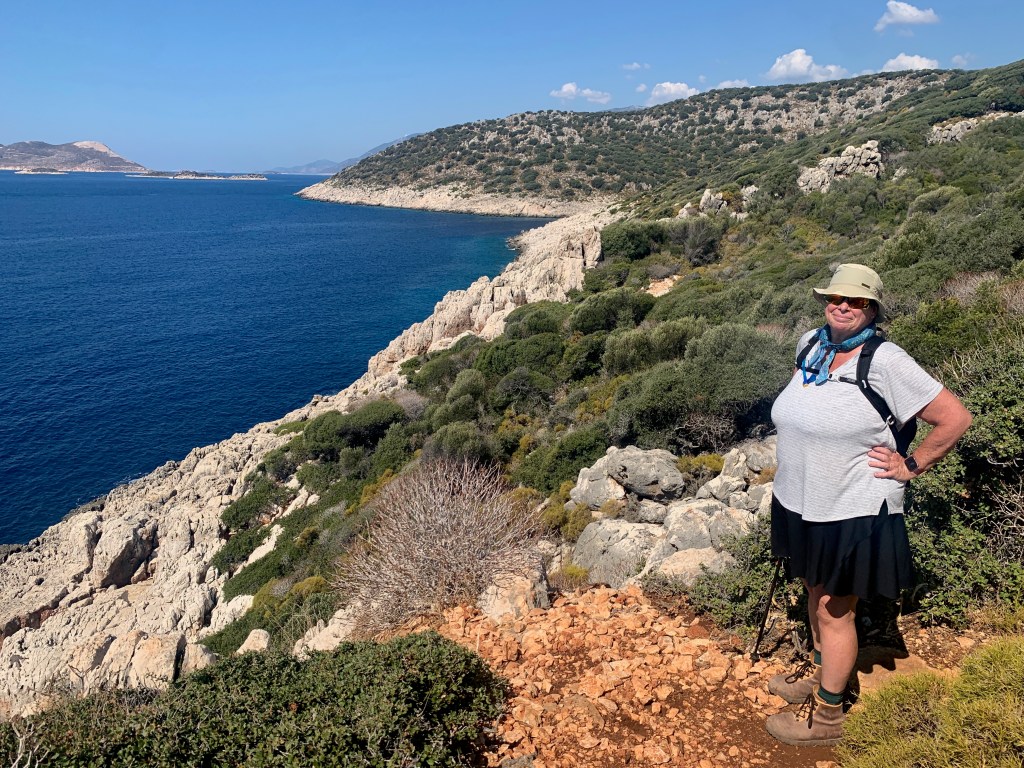
The itinerary Aydin created for us took us along the Aegean coast, past Kaş along the Mediterranean to Antalya, and then inland to explore Lake Kovada and Köprülü Canyon National Parks. Sometimes our routes took us inland to cycle along beautiful pine-forested mountains, spectacular canyons and beautiful lakes, and sometimes right along the coastline where rides and hikes took us right to the rocky/craggy shore and cerulean secluded Mediterranean coves. Having already done three other Türkiye tours with Aydin, he had us cycling and hiking along more scenic, less-touristed areas while still visiting import ancient sites and staying in lovely beach resort areas.
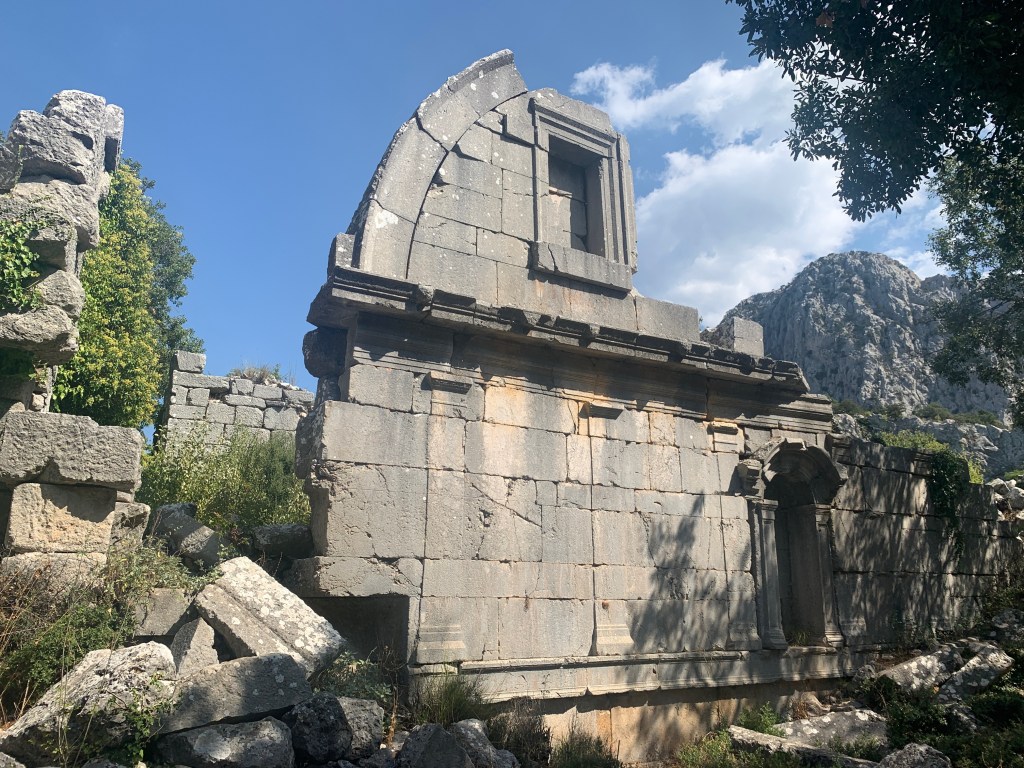
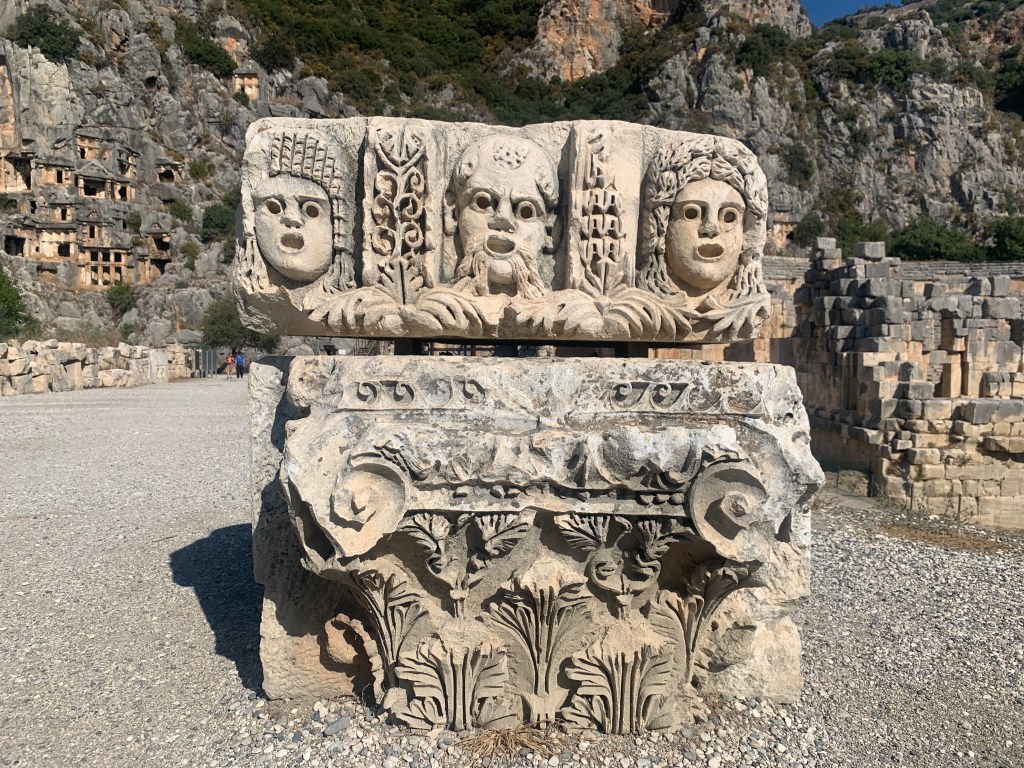
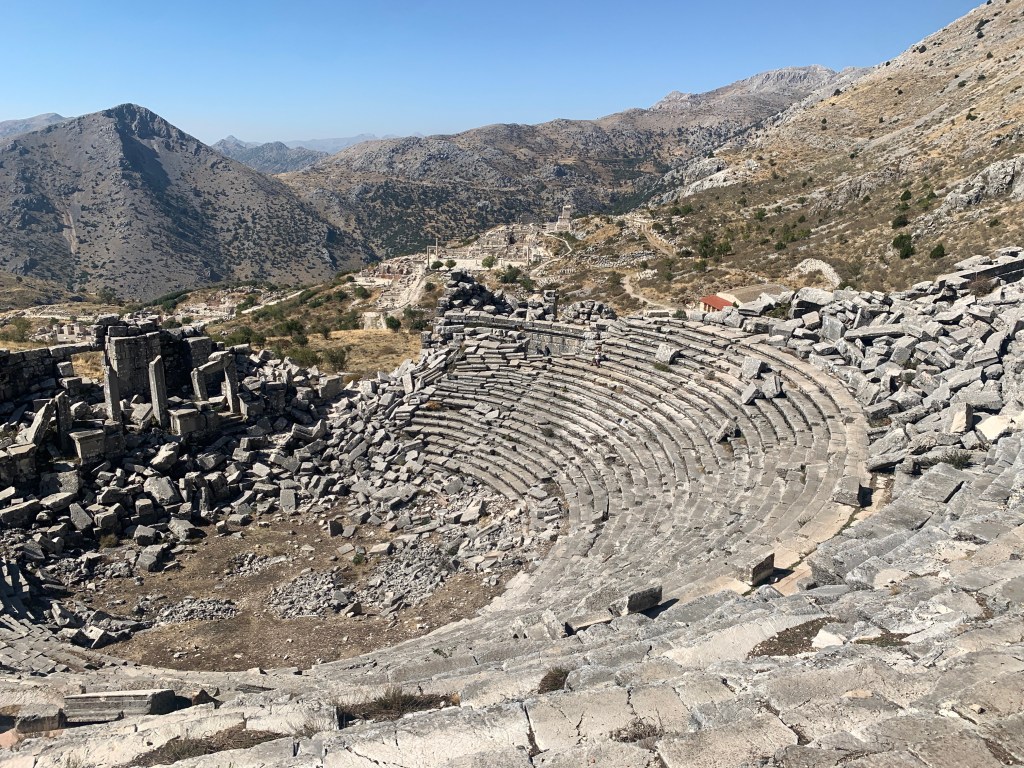
Most of the amazing archaeological sites we visited were Lycian sites (a civilization that reigned from the 14th Century BC to 546 BC). Almost all of them went through Lycian, Persian, Greek, Roman, and Byzantine phases. The highlights include:
- Pinara has hundreds of tombs carved on the steep slope above the acropolis. What’s really cool is that you can actually go into a few of them.
- Xanthos has the most beautiful and well preserved example of Lycian pillar tombs: the Harpy Monument. It’s spectacular, though as the explanatory sign near the tomb states, “… the original of these embossments surrounding the burial chamber was abducted to the British Museum…”
- Myra has an impressive set of 4th & 5th century BC rock cliff tombs, and beautifully carved buildings.
- Termessos, mentioned in the Illiad, and visited by Alexander the Great, you have to be a mountain goat to visit this site properly. It has the most amazing location for a theater, right on the edge of a steep cliff looking out on amazing vistas. One of my favorite-ever sites.
- Sagalassos, high up in the Taurus Mountains, a Psidian (not Lycian) city before Alexander the Great conquered it, is my absolute favorite Turkish site. It’s huge, spectacular, and has magnificent buildings with majestic views. We first visited 24 years ago, It was fascinating to see how much of the site has been uncovered and restored since we were there, including the restoration of two spring-fed Roman fountains. It’s mind-boggling to stand there and see water flowing through fountains that Emperor Hardrian would have seen. If you can only visit two Turkish archaeological sites, go to Ephesus and here.

Boot Camp Aydin.
Aydin created a daily program of challenging activities mixed. Our tour started out with a bang (if not a slap in the face). Minutes after disembarking our fabulous Turkish gullet, our Eon driver/guide, Osman, loaded electric bikes onto the back of a minivan and drove us from Bodrum to the start of our first ride: a 42 mlle (68 km) ride with some butt-kicking 10% climbs. That wouldn’t have been too bad, except it was almost unspeakably hot — 95°F (35°C) degrees and humid as all get out. Plus, when you’re cycling, the tarmac reflects heat back at you, so it was more like 105°F (40.5°C). Joy, being the smart one, opted out of that day’s ride.
Some days we did long rides, other days we did strenuous hikes, and some days we did modified triathlons: cycle, hike (running along the trails would have been suicidal), and then a swim (usually just floating around in the warm Mediterranean Sea or hotel pool). And squeezed into all that exercise, we’d spent time walking through the ruins of an ancient site. Over 11 rides, I cycled just over 350 miles and climbed 33,000+ feet (563 km/ 10,050 meters), with a few nasty, steep climbs complemented with some great downhills. The longest cycling day was 56 miles. Most of our hikes were in the 16 km (10 mile) range but the trails were anything but a “stroll in the park.” A few days into our Türkiye tour, Joy commented that it felt like we were training for a 10K by running marathons, but this was what we asked for!
In the saddle.
Our e-bikes were pedal-assist models. That is, no throttle. If you weren’t pedaling, you weren’t going anywhere. The bikes had three assist levels. I mostly set the assist to “1”, the lowest level of help. I had it to “2”, and only on the steepest climbs did I go to “3.” (Joy also didn’t use level 3 much, but it was comforting to know that if I was pushing hard, Joy could use the extra help to keep up.) E-bikes, by their nature, are heavy beasts — not as heavy as our touring bikes with stuffed panniers, but hefty even so. Looking at my Strava (cycle tracking app), the e-bike added ~3 mph to my cycle speed. The e-bikes definitely made a difference, but it was still hard cycling. My appreciation for e-bikes has moved from “vaguely interested” to “I see one in my future.” You can never own too many bikes!
Each cycling day I regretted leaving all our cycling gear in long-term storage in Amsterdam. I now have a deep-seated appreciation for my bike chamois. Two hours into every day’s ride, my main concern was my rear end. Several of the road surfaces were paved in rough, pebbly tarmac and those vibrations wrecked havoc on our wrists and our bums. We both particularly missed the specialized butterfly handlebars we have on our touring bikes, which greatly reduce hand and wrist pressure when you’re spending hours in the saddle.
On Foot.
Most of our hiking was either along the Lycian Way or St Paul’s trail.
The Lycian Way is a 320 mile long (540 km)“way-marked” hiking trail in southwestern Türkiye that linked ancient Lycian cities and their Mediterranean ports. The British Sunday Times included the Lycian Way as one of the top 10 hiking trails in the world!
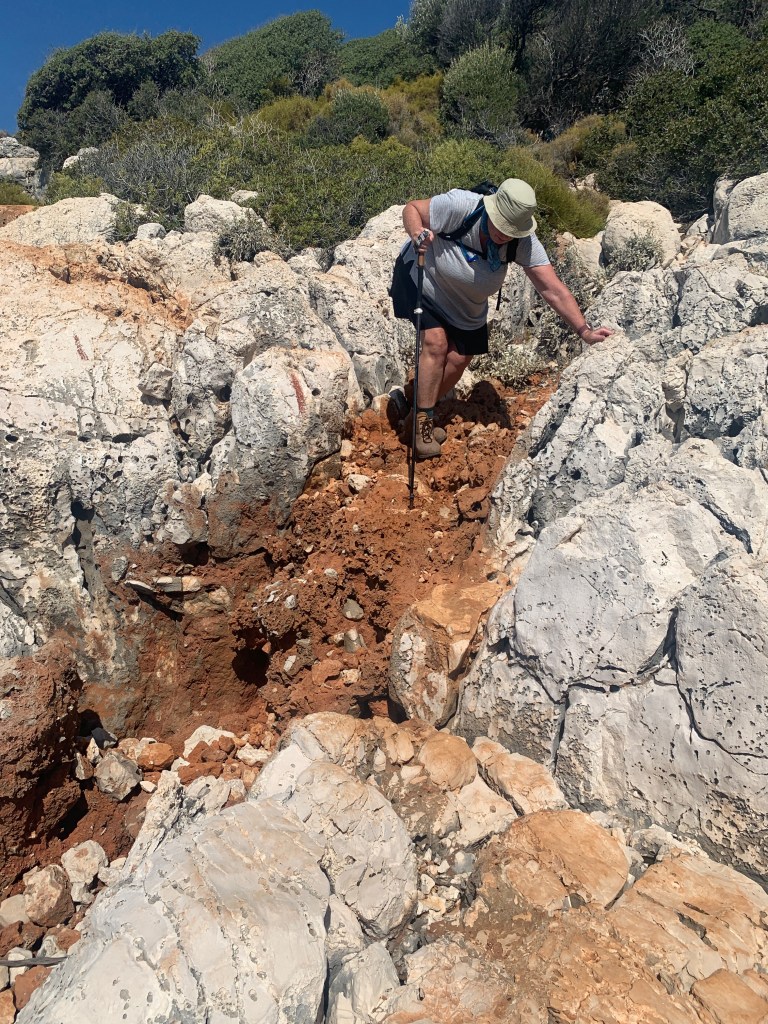
The trail is marked with a white stripe above a red stripe, usually painted on a rock or tree trunk. The marks aren’t always easy to see and other hikers sometimes pile stones to help identify the route. Even with the piled stones, following the trail is not simple. In some sections there are a lot of criss-crossing goat and wild game (mostly boar) game trails which look much more traveled than the actual trail, so it’s easy to find yourself following the wrong path. Or, you’re traversing rocks and boulders or squeezing your way through mazes of overgrown vegetation and most of your focus is on keeping your footing rather than looking for faded trail marks. Even with the GPS, we’d sometimes find ourselves several hundred feet off trail. More than once I found that I had lost the trail and the Garmin had lost signal. To add injury to insult, bushwhacking back to the trail sucked because that part of Türkiye has a lot of sharp, spiky plants. And rocks. My boots have gouges in them. My legs were worse. There were also a few sections of the trail that were just plain hairy because they hugged rocky cliffs and the footing was treacherous.
One reviewer in AllTrails (hiking app) describes the Lycian Way, in part:
Massively difficult – with intense – jaw dropping views and literal ‘one slip of the foot to your death’ sections. This coming from someone who does this stuff for a living….But still absolutely awesome and most of the people in the towns are really welcoming….Everything from Kas to Feithve is epic.
Even the official Antalya tourism site says, “Solo hiking is not recommended on this path….The path is sometimes very narrow and, it must be said, sometimes much too close to the cliff.”
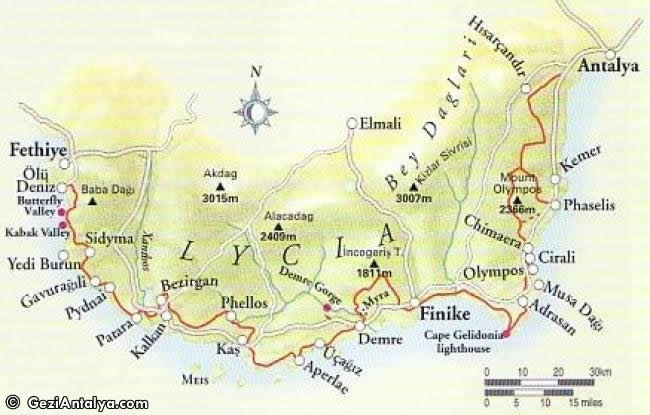
(For my Stanford University Library friends…. while searching for an official map of the trail, I ended up on the Wayback web archiving service!)
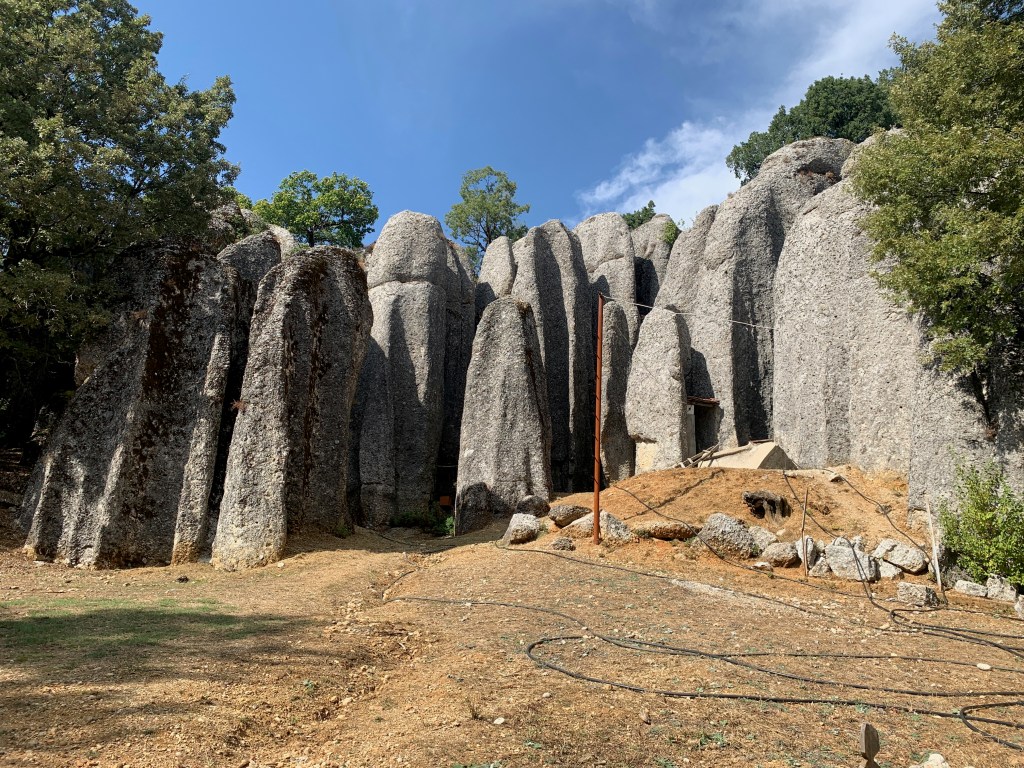
The St Paul Trail is a 500 km footpath that follows the route St. Paul the Apostle took on his first missionary journey to the Anatolia region of Türkiye (aka Asia Minor). It, too, uses paint markings to guide you along the way. We hiked through pine forests or wended our way through, over, and around towering outcroppings. Although the trail was generally fine (just steep) sometimes our route took us along sections of old paved Roman roads and sometimes along tough rocky footing. This trail was much wider and wasn’t anywhere as challenging as the Lycian Way, but even so, I can’t imagine doing this 2,000 years ago wearing leather-soled sandals. No wonder they’re all dead.

Tough but pampered
Although the activities were physically challenging, as with all Eon tours, we were as pampered as could be.
When we were cycling, Osman would follow behind us, his hazard lights flashing, and partially straddling the shoulder to give us a nice safety barrier from cars and trucks coming up from behind. It was comforting during some of the steepest, slowest climbs, when we were barely making 11 km/hour, that he was right there, protecting us. A few times each day he would zoom ahead of us, and when we caught up to where he’d pulled over into a large pullout, we’d find he’d set out a cooler with cold drinks, water, fruit, granola bars AND SNICKERS! Sometimes it was nice just to sit inside an air conditioned van for 5 minutes. In the morning he would load the day’s cycling route into the Garmin attached to my handlebars, and strap a two-way radio onto my bike in case we got separated and needed to talk. Each evening he would restock snack supplies, wash the bikes, charge up the bike batteries, and make sure all three bikes (we brought a spare!) were ready to go.
We’d never cycled with a sag wagon before, and certainly not a personal one. It was an awesome experience and I kinda felt like a Tour de France rider (except at super slower speeds and without the cheering crowds). Having Osman back there took so much stress off my mind. I’m faster than Joy and when the two of us are cycle touring, I’m always aware of checking my speed so we don’t get separated, or worried about traffic coming up from behind. With Osman back there, I didn’t worry at all. On the other hand, it was always tempting to bail out of a ride rather than endure discomfort or uncooperative weather as we did when cycling EuroVelo 6.
When we were hiking, Osman would hand us the Garmin and the radio and tell us where along the trail he’d meet us (usually around the 5 km mark). When we’d get there, we knew we’d see the cooler and snacks laid out. A few times, when the trail topography was particularly challenging and our pace was slower than usual, we’d find Osman hiking towards us, carrying water, drinks and snacks. Joy referred to Osman as our guardian angel.
Sometimes, he was also toting the drone. Osman brought a drone along and sometimes, while cycling or hiking we’d hear a drone hovering nearby, which was both cool and sometimes sucked because I then I felt obligated to “make it look pretty.” He spent time teaching each of us how to fly the drone. Joy is considerably better at it than I am. I’m certain there will be a drone-shaped package under the tree this Christmas.
Between the drone and an e-bike, this is going to turn into an expensive trip!
When our Türkiye adventures were finished I wrote Aydin the following email:
Did Osman tell you I am mad at you?
Why am I mad at you?
Because my face hurt the entire time we were with Osman.
Why did my face hurt?
Because I was smiling all day long for 18 days.
The following video (click arrow to watch) summarizes the beauty and challenges of our fabulous time in Turkey.
Spain – Camino de Santiago
The Camino de Santiago is a set of dozens of pilgrimage paths (starting from various points in Portugal, France, and Spain) that lead to the shrine dedicated to Apostle James, located in Santiago de Compostela, in Northwestern Spain. What the heck was Apostle James (St James the Greater) doing in Spain? According to legend, after the whole Easter thing (let me know if you need a refresher), James and the remaining apostles wandered around preaching. James’ travels took him to Spain for a while, but he returned to Judea after seeing a vision of the Virgin Mary. After his death, his body was transported from Jerusalem back to Spain and people started coming by to check out his bones. He ultimately became Spain’s patron saint and a destination point.

People who walk, ride a horse (and, in recent times, a non-electric bike), along the Camino are officially referred to as “pilgrims.” (For purposes of this post, I’ll refer to other folks on the Camino that way.) Pilgrims have been making their way to St Jame’s shrine since the 9th century. Things took off in 1492 (after the Spaniards kicked the Jews out of Spain) and the Pope decided that Santiago should be one of the “three great pilgrimages of Christendom”, the other two being Jerusalem and Rome.
Pilgrims carry a “pilgrim’s passport,” called a “credencial” which gives you access to hostels (“albergue”) usually run by the local parish or other religious groups. Pilgrims get their passports stamped with an official St James seal at any albergue, hotel, restaurant, etc., as proof that they’ve been on the pilgrimage and followed the “rules” to make them eligible for the “compostela” certificate of accomplishment. There are two versions of the compostela: a religious version (which also includes some level of indulgence), and an “it was a good walk” kind for us non-religious types. To be eligible for a compostela, a pilgrim must: 1) make the pilgrimage for religious/spiritual reasons or at least have an attitude of search, 2) do the last 100 km on foot/horseback or cycle the last 200 km, 3) collect at least two credencial stamps each day. I didn’t bother getting a compostela. The certificate seems superfluous compared to the experience. According to Mr. Wikipedia, in 2022 just shy of 440,000 pilgrims finished the last 100 km.

Buen Camino
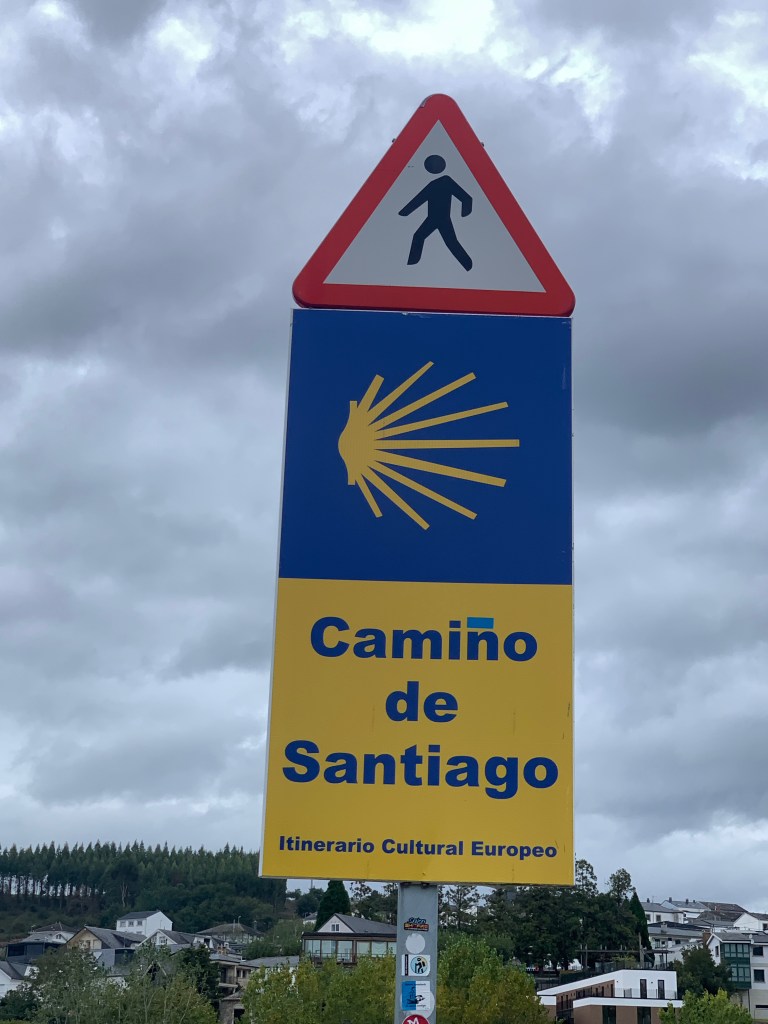
Joy and I walked along the French Way (Camino de Santiago Francés), the most travelled of all the pilgrimage routes. The whole Camino Francés is 780KM (~500 miles). Our trip started in Sarria, the most common starting place for pilgrims looking to do the bare minimum to qualify for the compostela. Sarria is actually about 120KM from Santiago, but it’s the town closest to the 100 km mark that’s big enough to have train/bus service. There are a few towns along the way, but most of the places between Sarria and Santiago are, at best, a village, and often not even big enough to be called a hamlet. But they always had a place to stop and get a meal, use a bathroom, and stamp your credencial. Most of our path was along rural trails skirting farmland, cutting through chestnut & oak forests, or through eucalyptus groves destined for pulp. The landscape was sometimes pretty, but never special. The last day is know as being boring and mostly ugly, running along the airport and industrial areas, and then through a long stretch of modern Santiago before reaching the historic center and the cathedral. Joy cleverly bailed on the last day.
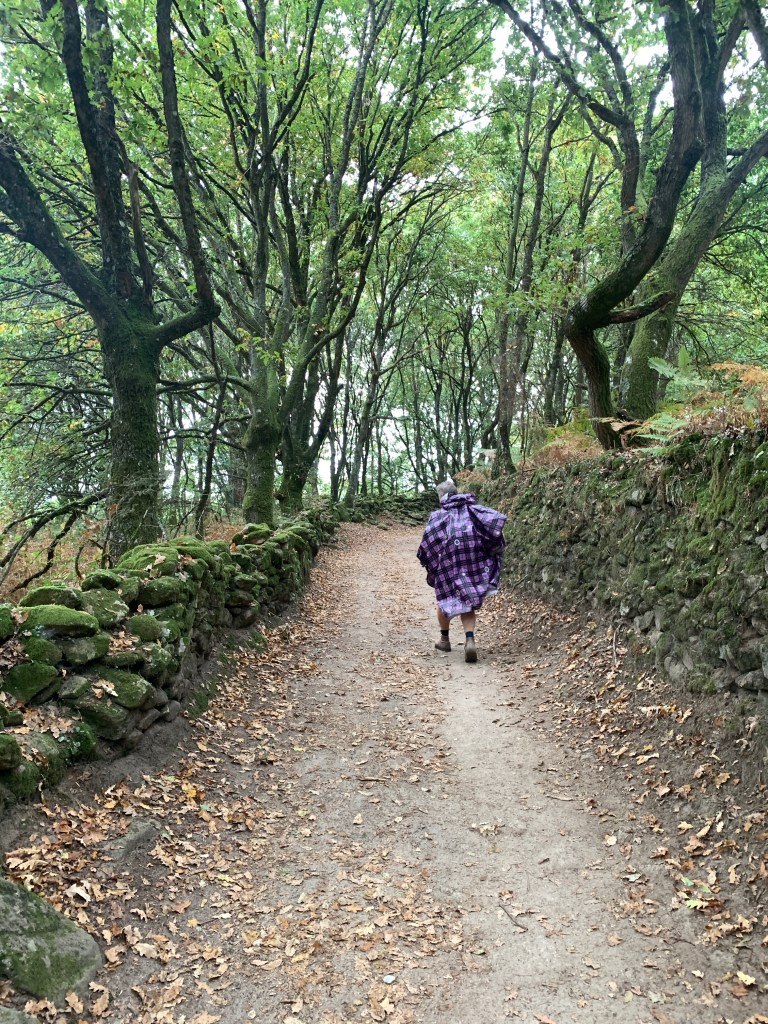
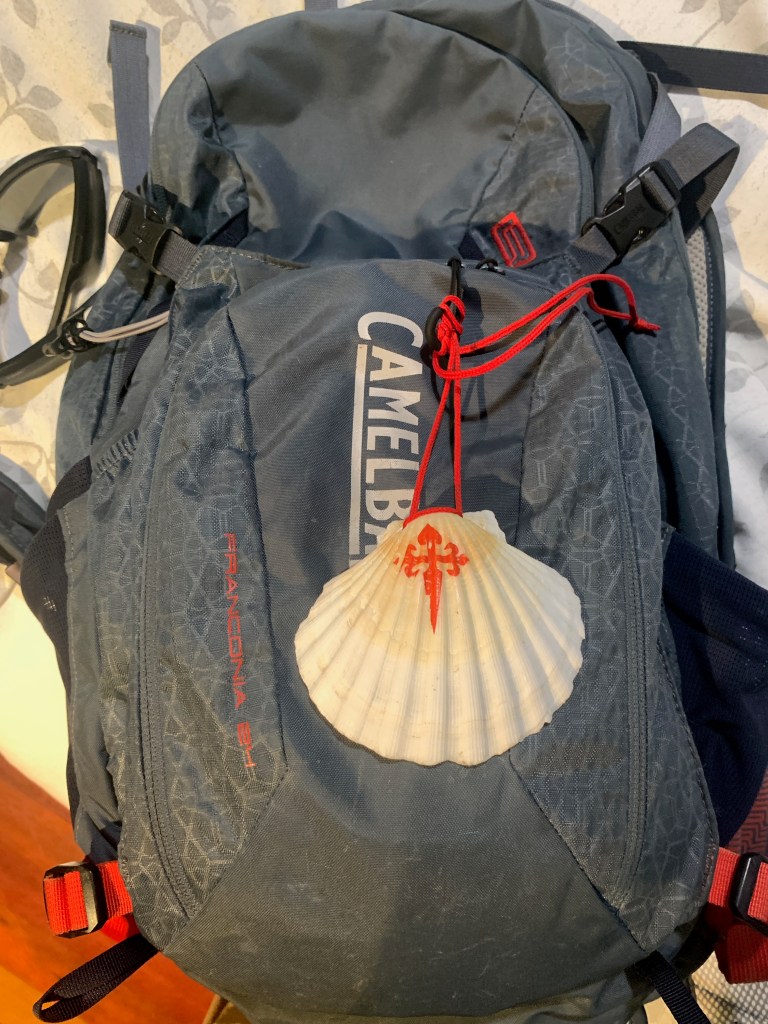
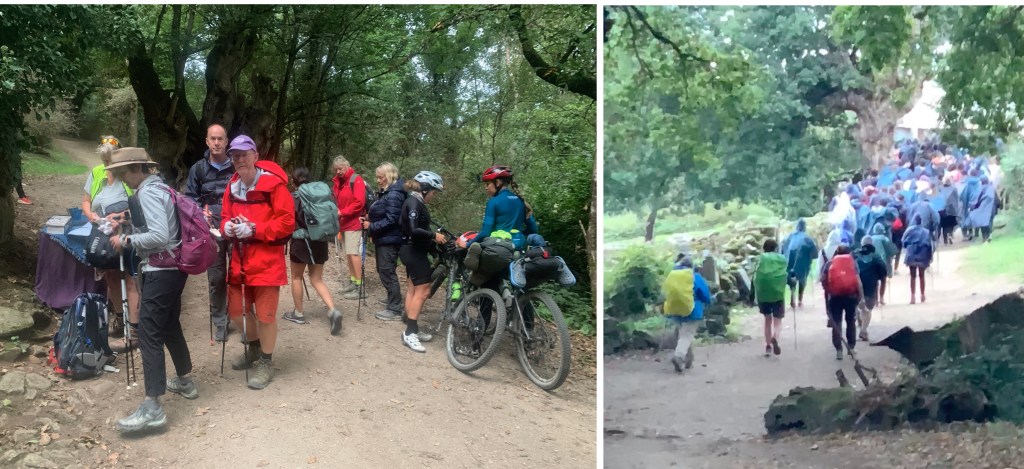
Walking the Camino has some unusual and memorable aspects.
Surrounded by others but alone. For many pilgrims the walk was a religious experience. For everyone, a rare opportunity for reflection. During rest stops, or over breakfast, other pilgrims would often mention how much thinking and reflecting they were doing. We are, all of us, surrounded by so many daily distractions and demands on our time that it’s unusual to have time to explore your own thoughts for any extended time, let alone for several hours at a stretch over several days. Between our long cycle touring rides and other long hikes, Joy and I already had plenty of opportunities for self reflection this year, so this was nothing new to us.
Walk this way. Everyone on the Camino a shared destination: reaching the Cathedral 100 km away. That meant we were all walking in the same direction, along the same path, all turning left at that marker, right at the next marker, etc. Over the course of our six walking days, we saw less than two dozen folks walking in the opposite direction — and it was always obvious that they were locals. Walking in the same direction as a bunch of strangers for several days is a really weird experience.
An ephemeral fellowship. Most pilgrims tackle the Camino the way we did: arranging with a service to book accommodations along the way and to transport our luggage from one hotel to the other. Everyone in our Sarria hotel was a pilgrim and a subset of them stayed at the same hotel as we did each night. Our walking cadence was such that we encountered the same sets of people each day (the husband and wife from Fresno, the young Spanish couple with the Galgo (Spanish greyhound) dog, the Asian-American dad and his 12-year-old son, the Chinese woman who had been walking the Camino for 52 days, etc.). We’d either bump into each other at a random cafe along the way, pass each other along the trail, or hobble into the same restaurant for dinner. We’d created an ad hoc and casual community — that dispersed the moment we reached Santiago.
A few other observations.
- Pilgrims seemed to either be in their early 30s or late 60s/early 70s. One group mostly wore spandex. One group mostly wore crosses.
- Most pilgrims were groups of two, and a fair number were solo walkers. Joy and I both noticed how may solo women pilgrims there were.
- It is traditional to greet pilgrims with “Buen Camino” (‘good path”). The first day everyone called out enthusiastic “Buen Caminos” as they passed each other. As the days wore on, and people’s walking paces slowed while the amount of limping increased, people seemed to shrink back into themselves and offer fewer and fewer salutations.
- I’m positive that Joy and I are the only pilgrims to ever wear purple Scottish tartan ponchos on the Camino. Best £3 purchases ever, but so happy to trash them when we were done.
- After 75 miles of being impossible to get lost because there were official Camino markers all along the path, it annoyed me that signs disappeared about 1/3 of a mile from my destination. I “lost my way” and had to ask for directions to the Cathedral. On the other hand, that seems appropriate given that I wanted to be a Catholic priest when I grew up, and now I haven’t the faintest interest in organized religion.
- The cathedral is beautiful but we skipped standing in line behind hundreds of people to see St James’ reliquary.
Which Path is Right for You?
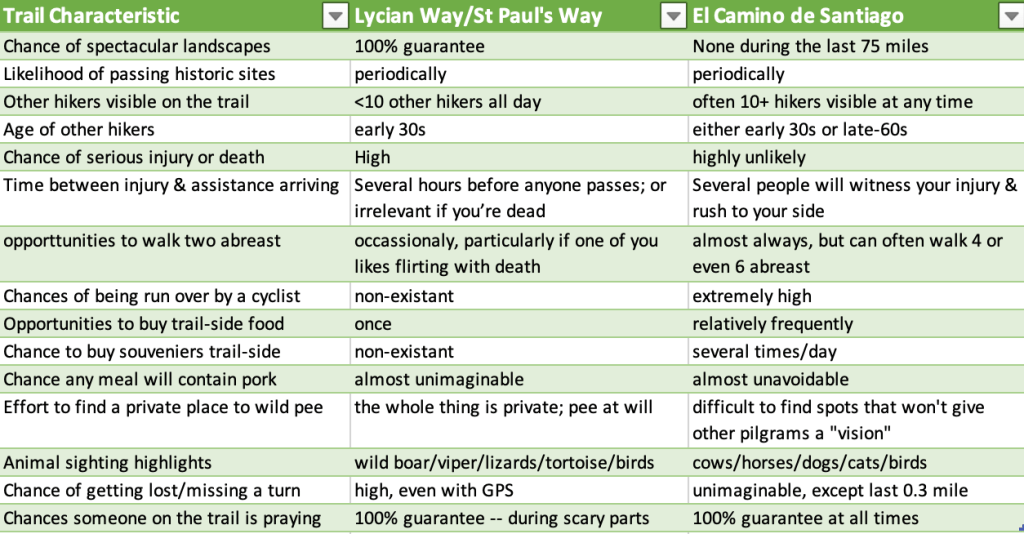
At this point, you’re probably chomping at the bit to do some of the hiking/biking Joy and I did over the past month, but you’re struggling to decide which one would be best for you. We’ve identified 15 differentiation points between our two sets of walks to help you decide.
Keep in mind that we only walked portions of each route. We missed out on the scenic/wilderness sections of the Camino and skipped the easy, crowded stretches of the Lycian Way & St Paul’s trails.
A year of travel: running totals
As I write this, we have *just* returned to the US (but not yet home). The stats below include our post-Spain travel to Stockholm for a few days before we flew back to the US. 10+ months into our year-long trip we have been in:
- US States: 7 (Oregon, California, Arizona, New Mexico, Texas, Louisiana, Mississippi)
- Countries: 18 (US, Mexico, Cuba, The Netherlands, Belgium, France, Switzerland, Germany, Austria, England, Kenya, Wales, Greece, Scotland, Norway, Turkey, Spain, Sweden)
- plus two unofficial, 60-second visits into Guatemala and Tanzania for Tony
- Continents: 4: North America, Europe, Africa, Asia
- Different beds: we’ve slept in 131 different beds (140 if you include same hotel/house but different rooms each visit). That’s a different bed every 2.16 (or 2.31) days.
 Itinerant Philosopher
Enjoyed the read…and loved all of the stories about Türkiye and your experience on the Camino! Nice work on the highlights video. I think Joy must have been setting some speed records on those downhills! Take care.
LikeLike
So good to see your amazing journey! Remember if you want a gentle cycling experience with wine tasting, you have a place to stay in Walla Walla.
LikeLike
This is so much fun! I love the video and the traditional haircut at the end. 🙂 Great travelogs. I’ve enjoyed them all.
LikeLike