
Canterbury was the starting point for our month-long clock-wise tour of England that started in mid-May. This phase of our 11-month travel adventure was a major change of pace & scenery from our France-to-Vienna cycling trip.
Driving in England
Joy and I have plenty of previous experience driving in “left hand traffic” (LHT), as they do in England. Even so, driving in England is is a two-person exercise because it’s basically an obstacle course, choreographed dance, and intelligent test.
Fun facts: While we Americans tend to think that only a few countries drive on the same side as the English, it turns out 75 countries do, while 165 countries drive on the right. The US started out as a LHT country, but switched over around 1800. I guess part of a continuing revolutionary war F-You mentality toward England.
Roundabouts. England loves using roundabouts at “conjunctions” (what we call “intersections”). While most roundabouts are straightforward, some are complex, multi-lane beasts with lots of entrances and exits at weird angles. Google Maps will say something like, “Take the third exit,” and while the third exit is often at about 3 o’clock (if you think of always entering a roundabout at the 6 o’clock position and driving clockwise) sometimes, that third exit can be at the 5 o’clock or even 11 o’clock position. The person riding shotgun watches Google Maps and tells the driver about the upcoming roundabout, e.g., “Okay, it’s the 3rd exit, which will be about one o’clock” and then counts out the exits as we pass, “1, 2, exit here.”
“You-have-to-be-kidding-me” narrow roads. The Brits have a long tradition of defining field borders with stone walls or tall, dense hedges. That makes for lovely landscapes, but sucks when they define the edges of roads, because there’s rarely a verge. Like, not even a pretense of a shoulder. This makes for exciting driving when you’re on a narrow road. Some country roads are theoretically wide enough for two cars to pass, but only if one car squeezes over far enough that the passenger side mirror is almost flicking hedge leaves. Other country roads (and we drove on a lot of these) are only wide enough for one car, and when two cars meet, one car has to squeeze into the nearest pullout or wide spot (and sometimes that means backing up a fair way). When we were on these roads, if the hedges weren’t so tall that it felt like we were driving inside a hedge maze, shotgun was responsible for helping to spot on-coming cars in time to identify a pull-out area. (press arrow to watch the video.)
Parked cars. England has a dearth of parking spaces so people parallel park in the road, turning short stretches of two-way roads into one-way affairs. Let’s say I’m driving North along a road. After about 30 yards, I’ll see that my lane is blocked by parked cars. If no South-driving cars are near, I drive on the wrong side of the road until I can move back to my side. It’s particularly challenging when cars are intermittently parked on both sides of the road so you and oncoming cars end up taking turns driving on the wrong side. Fortunately, because we’re in England, drivers are polite and it’s kind of a game of “after you.” In the US, this would devolve into a game of Chicken — and road-rage induced shootings.

Unwanted Excitement. Near the end of our England tour we experienced the kind of adventure no wants to have. A tire (or, I guess, “tyre”) blew while we were traveling 70MPH along a highway. We ended up on a stretch of road with a minimal shoulder that wasn’t wide enough for us to leave the vehicle, so we sat in the car with our seatbelts on and waited for the repair truck. Every time a truck went by, the car shimmied!
Take a Hike
Joy and I settled into a routine of visiting one or two English Heritage or National Trust sites each day, and then going for a long “walk” through the countryside. Technically, no one in England hikes — even when you’re wearing hiking boots, using hiking poles, climbing up a steep ascent, and you’ve gone more than 5 miles. If you’re in England, you’re “walking.”
Walking is another long English tradition (if you’ve ever read any Jane Austen, you’ll remember a twisted ankle or two). Walks in England are primarily along public right-of-way paths and horse trails through villages, fields, pastures, and forests. It was a lovely way to experience the variety of landscapes and flora in each region of England. Our walks took us through glorious wildflowers meadows, rolling grassy fields, forests, craggy hills, and fabulous wind-swept moors. Many of our walks were through areas designated as “Areas of Outstanding Natural Beauty.”
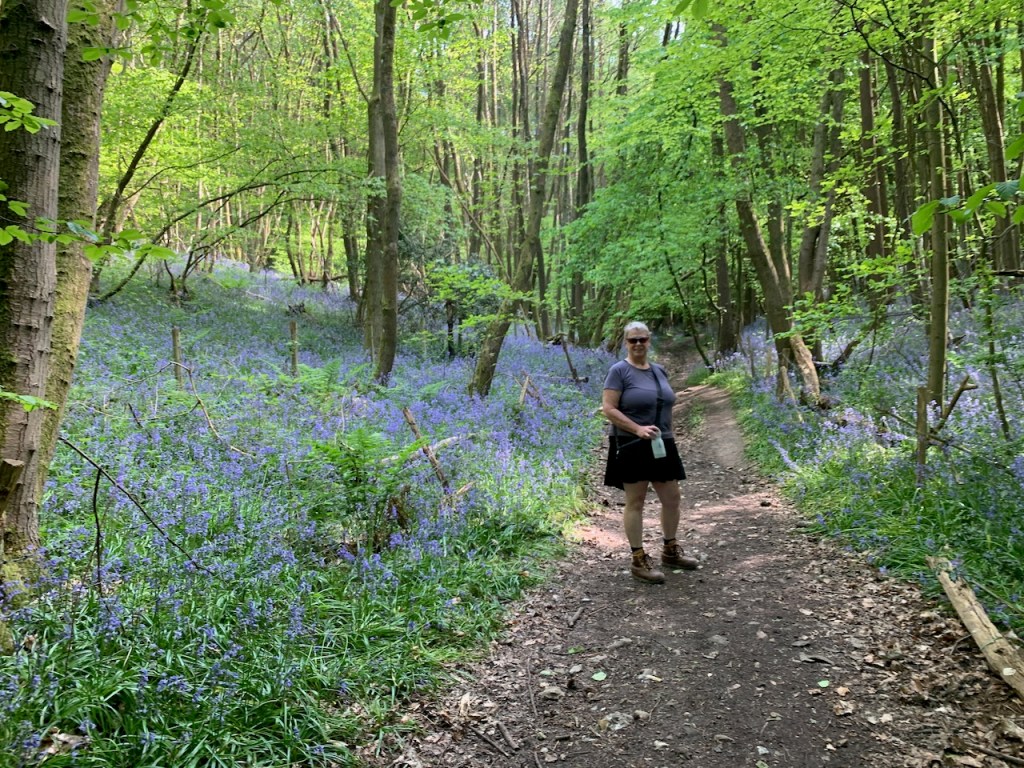

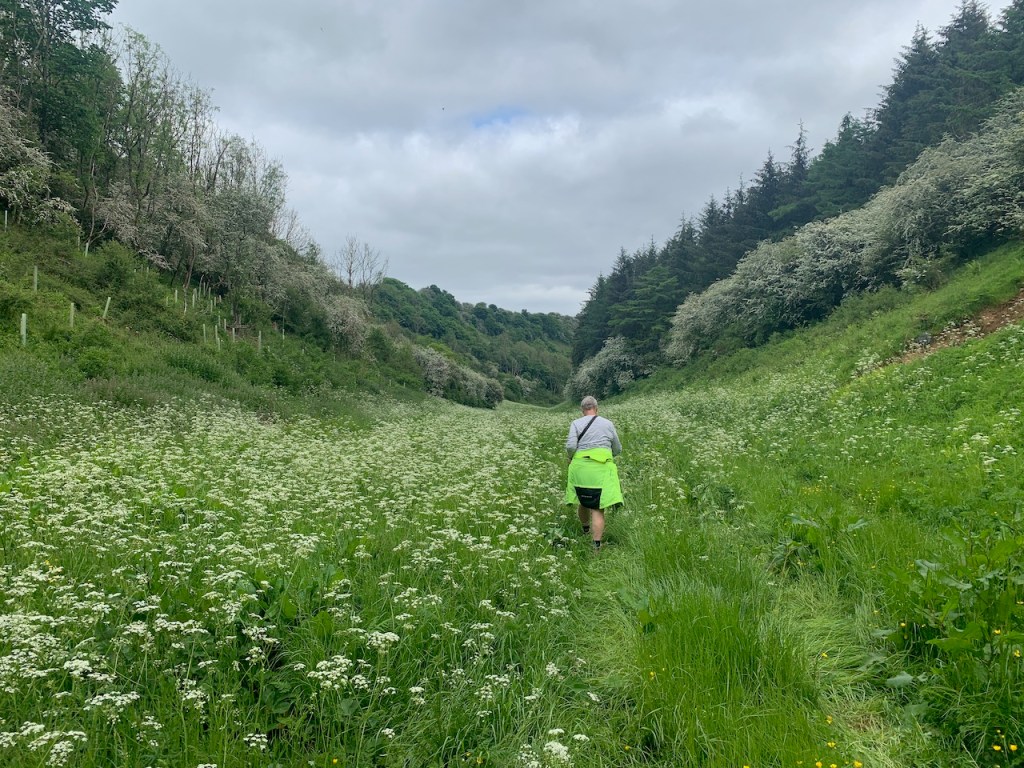
One of the challenges of these walks are the walls, hedges, and fences you need to negotiate as you cross private land. You’re often cutting through sheep or cattle grazing areas, or walking along agricultural fields. You negotiate these obstacles via stiles. A stile can be as simple as a gap in the stone wall that is barely wide enough to squeeze through (if you turn sideways). Periodically, a stile is a “kissing gate” (a one-at-a-time turnstile). Sometimes a stile is an elaborate set of wooden steps, or even a set of stone steps built into the wall. Most often, stiles are a gate with some kind of latching mechanism guaranteed to be a brain teaser. It seemed that no two stiles were the same. You might need to lift up on a handle, or pull a lever sideways, unhook a rope loop, or some kind of jerry-rigged variation latching mechanism. It was surprising how often it would take both of us to figure out how to get through a stile.

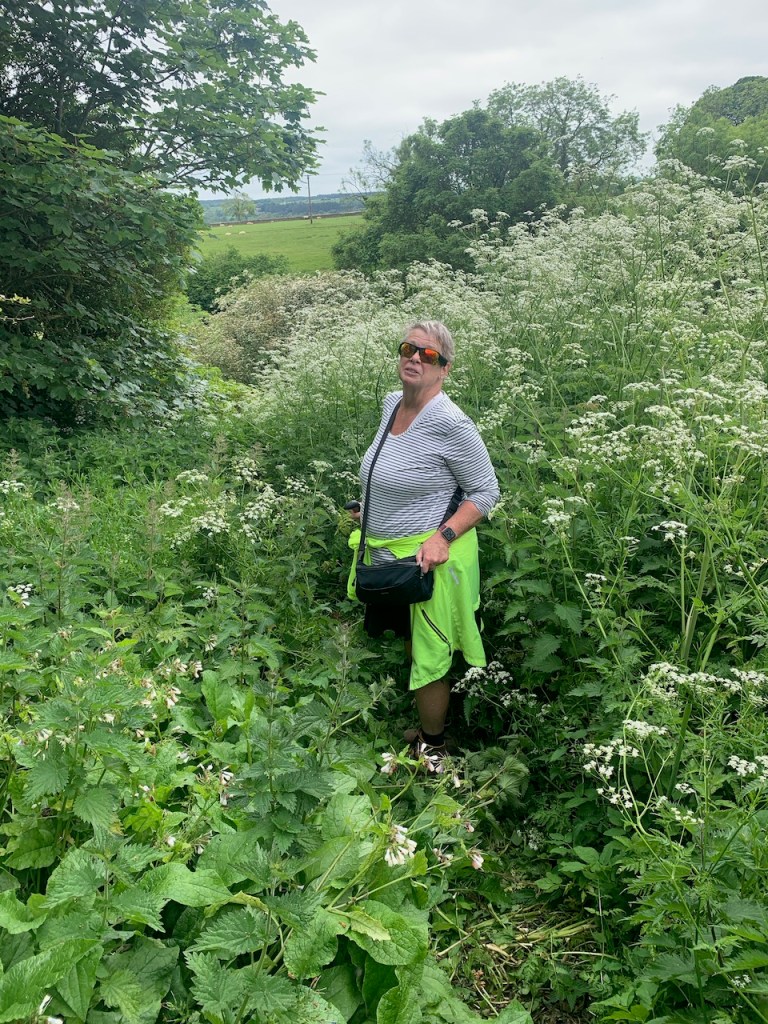
If we weren’t negotiating stiles, we were negotiating nettles. We learned the hard way about England’s stinging nettles: innocuous-looking waist-high plants covered in tiny little hairs that sting like crazy when you brush against them. Even though I rarely use my walking sticks, I started using them to keep my hands above nettle height. One of our prettiest hikes took us through a field of nettles. Sadly, that was the day we both decided to wear shorts. Usually, the stinging abated by evening, but that time our legs stung and burned well into the next evening.
England Highlights
We cram-packed a ton of fabulous experiences into a month while completely avoiding London, which we’ve visited often. By the end, we’d overdosed on cathedrals, castles, abbeys, manor houses, and museums. On our first day we purchased memberships in both the English Heritage and the National Trust, which gave us free access to hundreds of culturally, historically, or environmentally important sites. The National Trust tends towards manor houses & castles while English Heritage is more focused on historical sites like Stonehenge, Darwin’s house, and Roman archaeological sites.
Here is a small smattering of highlights, in no particular order.
- Dover Castle sits, appropriately, along the White Cliffs of Dover, and just across the channel from France. It’s a fabulous medieval fortress, has one of the world’s oldest Roman lighthouses, and a labyrinth of secret wartime tunnels that played a critical role in saving British troops from the beach at Dunkirk.
- Down House, Charles Darwin’s house just south-east of London was amazing. He spent most of his adult life there, observing nature, running experiments (often with his children) in his garden, and writing his seminal books, including On the Origin of Species. Seeing his handwritten journals & observational notes was particularly special.
- 1066 Battle of Hastings & Abbey. Totally one of our favorite places. The audio tour of the battle site where William the Conquerer came over from Normandy and conquered the Saxons to establish England as we know it really brought history to life and that part of early English history finally clicked into place for me.
- Tintagel Castle is a spectacular, sprawling set of ruins on Cornwall’s dramatic coastline. Tintagel plays a key role in Arthurian legend, identified as the place where Arthur was conceived. Far below the castle, at the base of the cliffs, and only accessible during low tide, is Merlin’s cave, where he hatched his plans for Arthur. While we were there we tried “proper” Cornish pasties (a turnover-shaped pastry filled with beef & vegetables). BTW, “pasty” rhymes with “tasty”, but that’s not necessarily an adjective I’d used to describe them.
- Audely End House & Gardens was once one of the largest and most opulent houses in Jacobean England, until King James visited and wondered how the Earl of Suffolk was able to afford a bigger house than his. Suffolk and wife were convicted of embezzling and the house was “downsized” to 1/3 of its original size (don’t piss off the king). Even so, it’s still freakin’ huge and retains spectacular gardens and landscaping.
- The walk along the Cornish cliffs up to The Golden Cap, the highest point on the South West Cornish coast was one of our most beautiful, and steepest, walks. This area is in the “Jurassic Coast World Heritage Site,” where you’re not likely to see any dinosaurs, but there are lots of fossils to be found. We fortified ourselves for the walk by having lunch at the Anchor Inn, a beachside pub sometimes hailed as the best gastro pub in the country. We’d just spent six weeks in France, Switzerland, Austria and Germany, and this meal was as good as any we had there. (Sadly, I have no memory of what we ate, just that it was awesome.)
- Richborough Roman fort & amphitheater is where Roman history in Britain began and ended. Roman invading forces landed there in 43AD and it was the last fort they held. Many fortress walls still tower over the site, and the concentric defensive ditches are still impressive 2,000 years later. This was one of a gajillion Roman sites we visited.
- Kings College Chapel in Cambridge was mind-blowingly beautiful. Even after seeing a ton of cathedrals across all our years of travel, it was a star. While we were in Cambridge, we did the traditional touristy thing of going on a punting tour along the River Cam (in the US, we’d say “Cam River”). We were there just as students were finishing their exams so we couldn’t tour any of the colleges, but it was amusing to see some of them do the traditional celebratory jump into the Cam. (yuck).
- Gin Making! In Cambridge we attended a “Gin Making” class. (Finally, a use for our bathtub at home!) We tasted distillates & botanicals (cucumber, orange & grapefruit, cardamom, lavender, rosemary & thyme, etc) by spritzing them into our mouths and then creating a personalized gin by blending our favorites and deciding on ratios for each flavor profile. My gin creation tasted like a mediocre Hendrick’s gin. I named my creation “UnGINmaginative.”
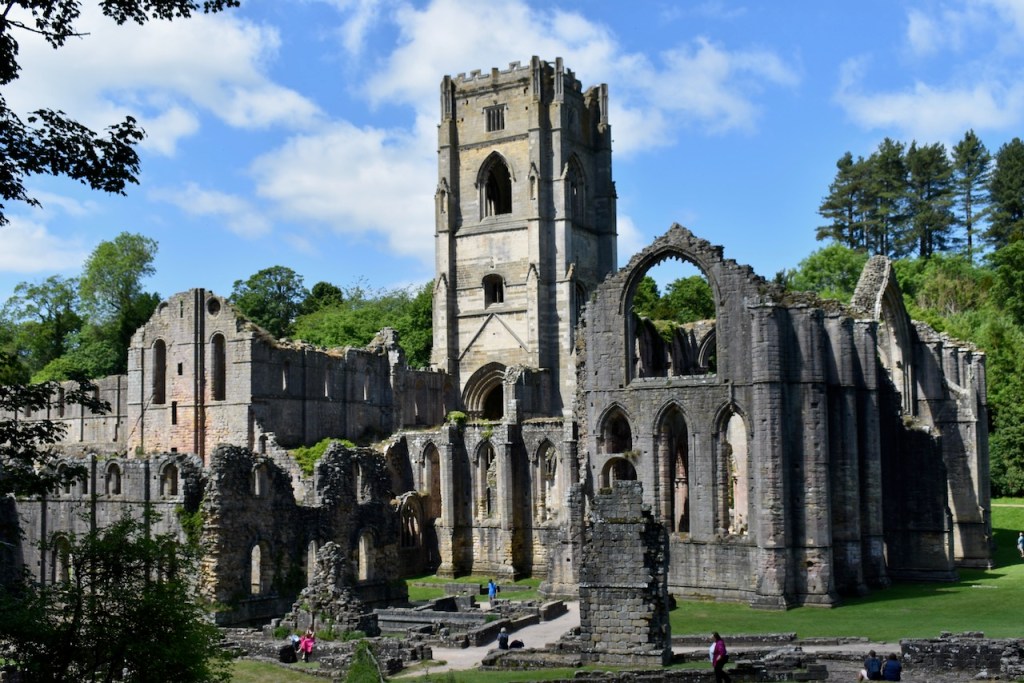
- Even among the highlights, Rievaulx Abbey was a highlight. The abbey ruins are ridiculously picturesque and have inspired generations of Romantic artists and poets in the 18th and 19th century. Rievaulx was one of the first Cistercian abbeys to be founded in England in around 1130, and was extremely wealthy, with more than 650 people there at its peak. As with all the abbeys we visited, it was mostly ruins, having first been “dissolved” by Henry VIII, and then eventually falling into neglect. Yet another example of Henry the VIII being a petulant, vindictive asshole after his break with the Catholic Church. On the other hand, we did learn that he had a very violent fall during a jousting tournament that left him unconscious for a while and after that his personality turned for the worse. So maybe he was the first famous case of chronic traumatic encephalopathy (CTE).
- Shakespeare/Stratford upon Avon. As many times as we’ve been in England, we’ve never been out to visit the Bard’s haunting grounds. We went on an interesting tour of Anne Hathaway’s (Shakespeare’s wife) family home, walked by Shakespeare’s too-crowded house, and attended a Royal Shakespeare Company performance of Cymbaline. I really enjoyed the show, though there’s a reason you rarely see it performed. It’s not his finest work (or even good).
- In Richmond, we toured The Theater Royal, a Georgian-era theater repurposed for various mundane things like a warehouse before being “rediscovered” in recent years and restored as a magical, intimate performance space. This theater is dear to British royalty and during our tour Joy and I happened to sit in the seats that then Prince Charles and Camila sat in. So, indirectly, my butt has touched King Charles’ butt. I don’t think that’s really something to brag about, but, hey.
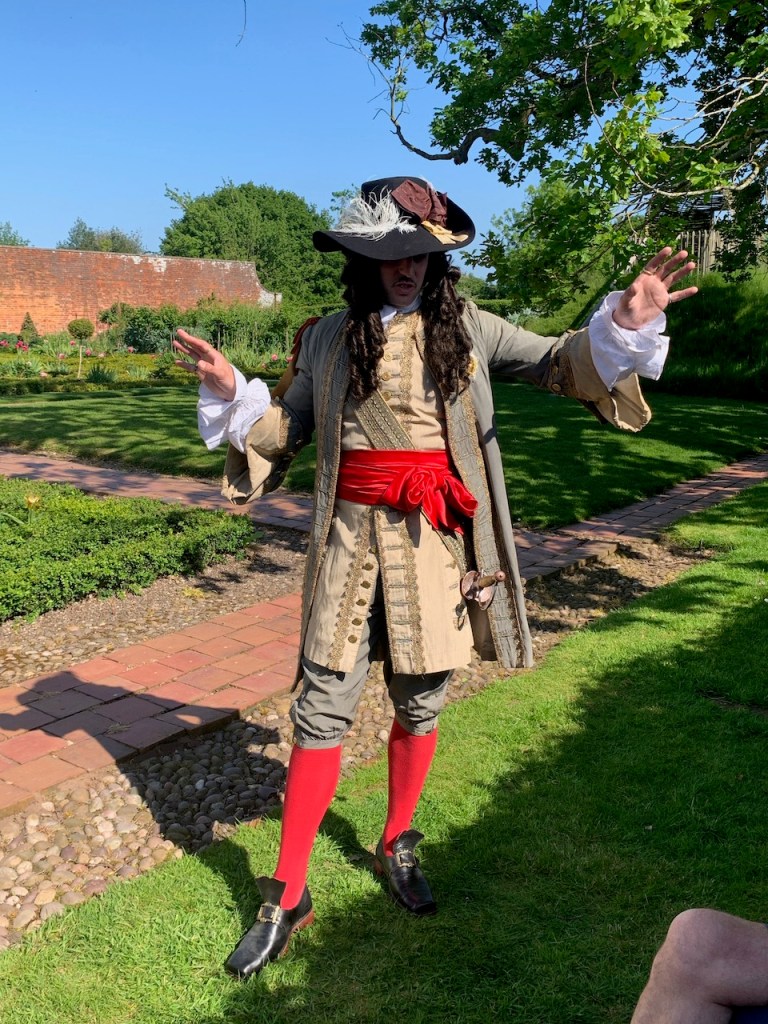
- In late May we visited Boscobel House & Royal Oak. Boscobel is the estate where Charles II hid in an oak tree all night in 1651 to avoid Cromwell’s Parliamentary forces during England’s civil war. The original tree, known as the “Royal Oak,” has died, but an acorn sprouted just yards away and is now a magnificent, hundreds years old tree itself. Coincidentally, we visited Boscobel the day before the Bank Holiday (what we call a National Holiday) celebrating that event, and an actor dressed up as Charles II was roaming around the grounds. In character, he talked us through the two previous generations of kings, the civil war and the battle that led to him hiding in a tree, and then his journey to France disguised as peasant worker before his triumphant return to the throne. The actor, who was also a historian, was brilliant. He spent more than an hour with us and made that part of history come alive. This was another one of those experiences that helped make English history click into place for me. Interesting tidbit: North & South Carolina are named after King Charles, with Carolus being Latin for “Charles”.
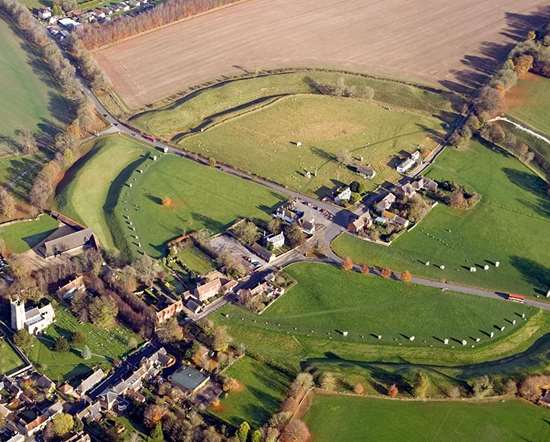
- Avebury henge and stone circles is one of the world’s largest Neolithic stone circles. It’s so big, it encloses part of the modern-day village of Avebury. We visited this as part of a beautiful walk across the Wiltshire hills that took us to seven different ancient sites. England is just filthy with cool archaeological sites! (The accompanying aerial photo is “borrowed” from the English Heritage site.)

A month seems like a long time, but even though we crammed a lot of sites into some days and totally skipped London, there were still lots of things we didn’t get a chance to visit. We didn’t get to Penzance, Liverpool (to see Beatles stuff), Bletchley Park, and totally missed the Lake District.
Running 11 Month Travel Totals To Date:
For purposes of this post, I’m only counting stats up until we left for Kenya in mid-June . Unlike when cycling, we’ve started staying in one spot for two or even three nights, so we were slightly less itinerant than before. Six months into our eleven month trip we have been in (though Joy missed out on Mexico):
- US States: 7 Oregon, California, Arizona, New Mexico, Texas, Louisiana, Mississippi
- Countries: 9 (10) US, Mexico, Cuba, The Netherlands, France, Switzerland, Germany, Austria, England
- plus, Guatemala when the boat momentarily crossed onto the Guatemala side of the river
- Continents: 2: North America, Europe
- Different beds slept in: 68 (76 if you include same hotel/house but different rooms each visit), which averages, depending on how you count, a different bed every 2.2 or 2.5 days.
Next Up.
As I write this, we are flying back from our Kenya safari on our way to 10 days touring Wales, then a few days in London with Joy’s sister before heading to Greece for Joy’s nephew’s much-postponed wedding (curse you, Covid-19!). Then off to Scotland for a week-long walking tour, then the Fringe Festival in Edinburgh. And then a bunch more stuff. Look for an upcoming blog post about Kenya.
 Itinerant Philosopher
One thought on “A Thirty Day Jaunt Around England”